
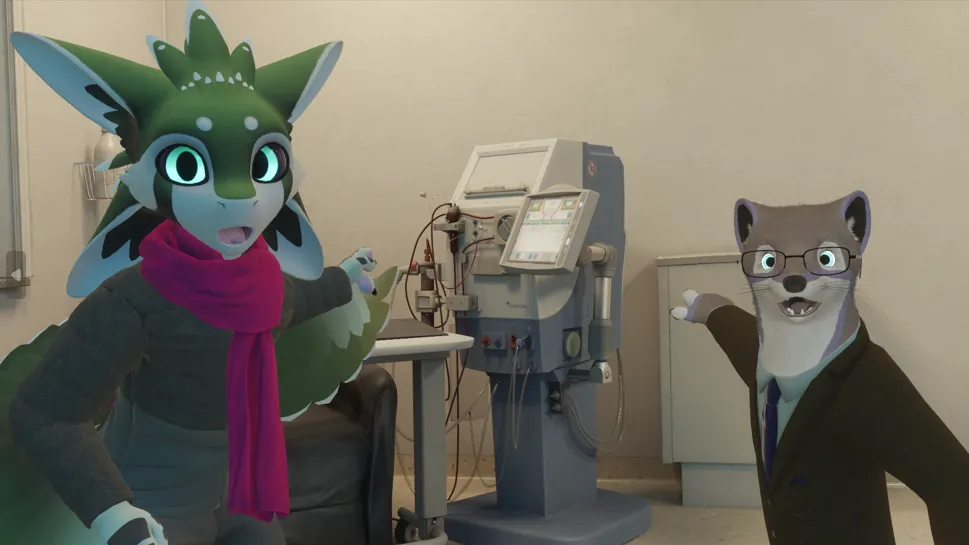
A friend flew from New York City to Stockholm to donate a kidney to someone he first knew through an avatar. That is the factual center of The Reality of Hope, a 30-minute documentary about Hiyu and Photographotter. The story does not ask viewers to pretend every online space is safe or every VRChat friendship becomes heroic. It asks a more grounded question: what happens when repeated virtual presence becomes trust, care, and action in the physical world?
Editorial note: This article discusses kidney failure, dialysis, surgery, and living donation. It is cultural analysis, not medical guidance.
A friendship that crossed from avatars into everyday life
It is easy to describe VRChat from the outside as a game filled with unusual avatars. That description notices the software and misses the social world. For regular users, a world can become a meeting place, an avatar can become a familiar face, and a weekly gathering can acquire the rhythm of a neighborhood. The graphics are rendered, but the time, attention, laughter, conflict, repair, and care between people are not fictional.
Hiyu and Photographotter’s VRChat friendship developed inside that kind of repeated social environment. According to Painted Clouds’ official film page, Hiyu was facing kidney failure when Photographotter traveled from New York City to Stockholm to become a living donor. The documentary was filmed both inside virtual reality and physically in Sweden, so the audience sees the relationship through the spaces where it actually existed.
This distinction matters. The internet did not manufacture a substitute friendship that later became real. The friendship was already real because the people were consistently present for each other. Travel, clinical evaluation, surgery, and recovery changed its stakes, but not its basic status. The Reality of Hope gives viewers a visible outcome that is difficult to dismiss: an online friend made a deeply consequential real-world choice.
What The Reality of Hope documents
Directed by Joe Hunting and produced by Hunting and Max Willson, The Reality of Hope was selected for the 2025 Sundance Film Festival’s Documentary Short Film Program. Sundance described the central story plainly: Hiyu faces kidney failure, and Photographotter travels to Stockholm to be a donor. The completed film runs 30 minutes and later received a full online release through The New Yorker on August 11, 2025.
The film is not only a sequence of medical milestones. It follows the waiting, uncertainty, fitness preparation, dialysis, travel, friendship rituals, community calls, surgery, and recovery surrounding the transplant. Its emotional power comes from accumulation. Small acts of presence build toward one enormous act of generosity.
The documentary also refuses to treat furry avatars as decorative camouflage. Hiyu and Photographotter appear through virtual identities that their friends already recognize, then through physical footage as the donation approaches. The movement between those forms does not expose a supposedly authentic person hiding behind a cartoon. It shows two ways the same people are encountered. That choice quietly challenges the idea that identity expressed through an avatar is automatically false.
The film’s closing thought captures the contradiction in a single sentence:
“People tend to say online friends aren’t real friends, but I got my kidney from one of them.”
That line is memorable because it is not a theory about the metaverse. It is a receipt from lived experience.
Why the film moves between VR and Sweden
Joe Hunting previously directed We Met in Virtual Reality, but this documentary crosses a boundary that earlier film largely preserved. As Photographotter travels and the surgery draws nearer, the camera moves from VRChat into airports, hospitals, homes, and Swedish landscapes. The physical journey gives the story weight, while the virtual footage explains how enough trust existed for that journey to begin.
One of the project’s most striking production choices is the virtual reconstruction of Hiyu’s dialysis room. Painted Clouds describes Room Between Realities as an exact VRChat environment rebuilt from real footage so the film could move smoothly between virtual and physical versions of the same space. That is more than a technical flourish. A medical room associated with restriction and repetition becomes a place that can be revisited, interpreted, and shared through the medium Hiyu helps create.
The reconstructed room also complicates the usual direction of digital imitation. Normally, people ask whether virtual reality can convincingly copy a physical place. Here, the more important question is whether the copy can carry memory. The room becomes a bridge between treatment, creative practice, and community witness. Virtual space is not presented as an escape hatch from reality. It becomes another chamber in which reality can be understood.
For an outside audience, this filmmaking method is useful because it prevents VRChat from being treated as colorful B-roll. The virtual worlds are part of the evidence. They show where conversations happened, how friends recognized one another, and why the Furality community could gather around two people separated by an ocean.
Furality was not background scenery
Hiyu’s role in Furality is central to understanding the social structure around the story. In the documentary, Hiyu discusses building virtual environments for an online furry convention whose events include panels, meetups, performances, and imaginative worlds. These are not simply attractions. They create recurring opportunities for people to work together, meet mutual friends, and become familiar over time.
That makes Furality a form of social infrastructure. Infrastructure is usually imagined as roads, buildings, or cables, but communities also rely on schedules, rituals, creative projects, shared norms, and people who keep showing up. A recurring virtual convention can produce all of those. It gives geographically scattered participants a common place and a reason to return.
The Sundance Institute’s Documentary Short Film Program framed the film as a story about care among chosen kin. That description fits because the donation did not emerge from one dramatic conversation between strangers. It emerged from a network where people had already built familiarity, witnessed each other’s work, and shared parts of everyday life.
Mello Zone’s furry and pup community topic hub approaches community through the same practical lens. Belonging is not created by a label alone. It grows through reliable events, clear boundaries, respectful creative collaboration, and repeated contact. The story in The Reality of Hope is extraordinary, but the social ingredients beneath it are recognizable.
The kidney donation was a human decision, not a platform feature
It would be careless to turn the transplant into an advertisement for VRChat. A platform did not donate a kidney. Photographotter did. Medical teams evaluated the participants, managed risk, performed surgery, and supported recovery. Friends helped sustain morale and practical support. Technology made continued connection possible across distance, but it did not remove the seriousness of living donation.
That distinction protects the story from becoming inspirational wallpaper. Living kidney donation involves medical, emotional, financial, and personal considerations. The historical fundraiser created during Photographotter’s donation process documented temporary travel, wage, and reimbursement pressures. The page is now paused, so it should be treated as a record of the journey rather than an active call for donations.
Donation also has to remain voluntary. U.S. guidance from the Health Resources and Services Administration states that a living donor’s decision must be informed, free from pressure, and reversible at any point before donation. The film takes place within Sweden’s healthcare system, so U.S. guidance does not describe the exact legal process shown. It does, however, illustrate a broader ethical principle: generosity is meaningful only when consent remains genuine.
No fandom, friend group, or audience should treat this story as a standard others must match. Care can mean making a call, sitting through a difficult night, helping with transportation, organizing meals, respecting a boundary, or staying present after the first wave of attention passes. A living kidney donation is one profound form of care, not a loyalty test.
What social VR research says about virtual reality relationships
One documentary cannot prove how every VRChat friendship works. Research cannot reduce Hiyu and Photographotter’s relationship to a chart either. The two forms of evidence do different jobs. The film gives depth to one case, while social VR research tests broader patterns among groups of users.
A 2026 Frontiers study of hyperpersonal relationships in social virtual reality surveyed a convenience sample of 131 very active users. Among the 113 participants who reported both a closest VRChat friend and a closest in-person friend, the VR relationship was rated slightly closer on average. Participants also reported interacting more frequently with their closest VR friend. Community belonging and successful self-presentation were positively associated with general closeness and enjoyment.
Those findings are interesting, but the limitations belong in the same paragraph as the result. Participants averaged roughly 26 hours of VR each week, many used advanced tracking, and the sample was small, young, and not representative of the general population. When the heaviest users were removed, the difference between closest VR and offline friendships was no longer statistically significant. The researchers also warned that a cross-sectional survey cannot prove VR caused the relationships.
A separate 2024 Frontiers study on identity and social interaction in VRChat observed that users who selected communities based on shared interests and trust developed meaningful connections and reported a sense of safety, belonging, and comfort. That finding helps explain why an event network matters. People do not bond merely because they occupy the same server. They bond when shared interests, norms, communication styles, and repeated experiences make trust possible.
Together, the research supports a careful conclusion. Virtual reality relationships can become emotionally significant, especially for highly engaged users who find communities where they can express themselves and return regularly. It does not show that every interaction is healthy, that avatars eliminate deception, or that time in VR automatically creates intimacy.
Why furry stereotypes make this story harder to see
A furry documentary about a kidney donation should not be surprising because furries are unusually angelic. It should be surprising only if someone has accepted a flattened image of the fandom. Public discussion often compresses millions of different creative and social experiences into a handful of sexual rumors, costume jokes, or shock-value anecdotes. That filter makes ordinary humanity harder to recognize.
FurScience’s summary of experienced stigma notes that furries often expect prejudice and worse treatment when others learn about their fandom identity. Its research on disclosure reports that 40 to 45 percent of surveyed furries said no one in their family, work, school, or day-to-day life knew they were furry. These findings come from specific fandom surveys and should not be treated as a census, but they reveal why accurate representation matters.
The strongest answer to furry stereotypes is not a campaign claiming the fandom is flawless. No large community is. The more honest answer is that furries are people, capable of ordinary conflict, creative brilliance, poor judgment, sustained friendship, and extraordinary care. A humane portrayal allows that full range instead of replacing one cartoon with another.
The Reality of Hope works because it does not lecture viewers into approval. It lets work, humor, fear, patience, and friendship accumulate until the stereotype becomes too small to contain what the audience has seen. The film does not demand that outsiders understand every avatar or convention tradition. It asks them to recognize the people participating in them.
What this story does and does not prove
The story proves that this particular VRChat friendship had life-changing consequences. It demonstrates that an online relationship can support trust strong enough to survive travel, medical uncertainty, recovery, and the ordinary awkwardness that follows a monumental event. It also provides a documented counterexample to the blanket statement that online friends are not real friends.
It does not prove that virtual communities are automatically safe. Online spaces can contain manipulation, harassment, fraud, dependency, coercion, and relationships that escalate faster than trust can reasonably support. The same immersive qualities that help people feel present can also make warning signs harder to evaluate. A moving documentary should not erase those risks.
It also does not prove that physical and virtual relationships are enemies competing for authenticity. Hiyu and Photographotter’s bond moved between text, voice, embodied avatars, mutual friends, travel, medical spaces, and face-to-face time. Its strength came partly from crossing channels. The virtual world was not a sealed replacement for life. It was one of the places their life together happened.
For safer participation, Mello Zone’s VRChat meetup safety topic hub emphasizes paced trust, account security, consent, private-information boundaries, moderation, and careful planning before an online relationship becomes an offline meeting. Hope and caution belong in the same toolkit.
How outsiders can watch without turning people into curiosities
The easiest way to weaken the film’s message is to treat its subjects as exotic exceptions. A headline that amounts to “look what the cartoon-animal people did” still places distance between the audience and the people onscreen. It grants admiration while preserving the assumption that furry life is fundamentally alien.
A better viewing posture begins with three recognitions. First, avatars are a form of self-presentation, not proof of deception. Second, online relationships are relationships whose quality depends on behavior, context, and time. Third, subcultures often develop their own visual language because participants are building places where they can be recognized by one another.
Responsible coverage should also credit the creators and subjects accurately. The film is directed by Joe Hunting, produced by Hunting and Max Willson, and rooted in the work of Hiyu, Photographotter, Furality contributors, and the artists who built the virtual production environments. Mello Zone’s creator attribution topic hub explains why screenshots, posters, artwork, and video should not be detached from their creators merely because they circulate online.
That principle applies to this article’s presentation. The official trailer can be embedded through YouTube’s privacy-enhanced player, while the full documentary should be watched through The New Yorker’s authorized release. Film stills and the Sundance poster should be used only when a press license or written permission clearly covers the intended publication.
What online communities can learn from the story
The most useful lesson is not “find a heroic donor.” It is “build conditions in which people can know and support one another responsibly.” That work is slower and less cinematic, but it is what makes durable care possible.
Community organizers can begin by creating recurring, accessible gatherings instead of relying only on giant one-time events. Familiar schedules help newcomers become regulars. Clear behavioral standards reduce uncertainty. Trained moderators protect the space without trying to control every friendship. Creative projects give members something meaningful to build together.
Communities also need room for practical support that does not become public spectacle. A member facing illness may want company but not constant questions. A fundraiser may need transparent ownership and a clear purpose. Volunteers may need defined tasks rather than vague pressure to prove they care. After a crisis, support should continue when attention naturally drifts elsewhere.
The Mello Zone manifesto treats inclusion as a practice supported by boundaries, consent, and accountability. Those principles matter here because strong community is not measured only by emotional intensity. It is measured by whether people can ask for help, say no, correct mistakes, protect privacy, and remain human when the dramatic moment ends.
The more honest contrast to the rumors
People outside the fandom sometimes encounter furry culture through an outrage clip before they meet a furry person. That order distorts perception. Rumor selects the strangest fragment, removes context, and presents it as the whole organism. The Reality of Hope reverses the lens. It begins with people creating worlds, maintaining friendships, enduring treatment, making jokes, organizing support, and choosing to remain present.
This does not mean every criticism of a furry space is prejudice. Communities should be evaluated by their rules, conduct, leadership, and response to harm. It means criticism should be based on evidence rather than inherited disgust. A fair observer can recognize both risk and value without turning either into a universal verdict.
For Mello Zone, the story is a useful example of why an 18+ SFW community should discuss more than discourse and defense. Fandom journalism should document creation, service, health journeys, accessibility, mutual aid, and the quiet labor that keeps social spaces alive. These stories do not exist to make the fandom look marketable. They exist because they are part of the record.
The contrast, then, is not “furries versus normal people.” It is rumor versus evidence. The evidence in this case includes a completed transplant, a 30-minute documentary, a Sundance selection, an international production, a recreated medical environment, and a friendship that continued across virtual and physical life.
Where to watch and learn more
The complete documentary is available through The New Yorker’s authorized video page. The official Painted Clouds project page provides the synopsis, runtime, release date, credits, and production stills. The official trailer is embedded above using a click-to-load player so YouTube is not contacted until the visitor chooses to view it.
Readers interested in the wider research can compare the film with the two Frontiers in Virtual Reality studies linked above. Readers considering living donation should rely on their own transplant program and qualified medical professionals, not a documentary or fandom article. The HRSA living donation guidance is a useful general starting point for understanding informed and voluntary consent in the United States.
Mello Zone publishes analysis under its editorial policy, which requires attributable sources, clear corrections, and separation between evidence and opinion. Our community resources page collects additional pathways for support and responsible participation.
The Reality of Hope does not make virtual life important by turning it into physical sacrifice. Virtual life was already important because people were listening, building, laughing, waiting, and caring there. The donation makes that truth impossible to wave away. Behind the avatars were never lesser relationships. There were people, and they showed up for one another when showing up carried real weight.
Why this article exists
The Mello Zone contribution: Mello Zone reads The Reality of Hope from inside the social-VR and furry context it depicts, connecting friendship, stigma, living-donation ethics, documentary framing, attribution, and responsible community storytelling.
by Mello Zone Editorial Team.
Published a sourced documentary analysis connecting The Reality of Hope to social VR research, furry stigma, living donation ethics, media attribution, and responsible community practice. Corrected the image alternative text to describe the displayed artwork; reporting and source-review dates are unchanged.
Read our sourcing, AI-assistance, and corrections policy.
Source links recorded for this article
- Painted Clouds official film page
- Sundance Institute: 2025 Documentary Short Film Program
- The New Yorker authorized documentary release
- Painted Clouds: Room Between Realities
- Frontiers 2026: Hyperpersonal relationships in social virtual reality
- Frontiers 2024: Identity and social interaction in VRChat
- HRSA living donation FAQs
- HRSA living donor informed-consent guidance
- FurScience: Experienced stigma
- FurScience: Disclosure
- Official trailer on YouTube
- Historical Photographotter fundraiser, donations paused
- Mello Zone furry and pup community topic
- Mello Zone VRChat meetup safety topic
- Mello Zone creator attribution topic