Mental-health scope: Furry participation is not evidence of trauma, illness, abuse, or dysfunction. Research does not support claiming that “most furries are traumatized.” This article examines why some people with difficult histories may find unusual value in fandom, creativity, avatars, play, and chosen community. It does not diagnose readers or replace professional care.
The face of trauma is rarely one face.
It may look like someone who startles when a voice gets louder. It may look like someone who apologizes for existing, disappears during conflict, trusts too quickly, trusts nobody, jokes through pain, overexplains, freezes, becomes fiercely independent, or builds an identity that finally feels under their control.
It may also look like a person who functions well, works, creates, laughs, attends conventions, and never tells the room what happened.
Furry fandom attracts people for countless reasons:
- Art
- Character design
- Animals
- Costuming
- Writing
- Music
- Games
- Performance
- Friendship
- Humor
- Technology
- VRChat
- Identity exploration
- Simple fun
Trauma is not the secret explanation behind all of them.
Still, some people enter the fandom carrying bullying, rejection, grief, unstable homes, discrimination, abuse, disability, isolation, identity conflict, or years of feeling socially misplaced. For them, a fursona, avatar, Discord server, pup identity, convention, or creative circle may become more than entertainment. It may become the first place where the self feels editable, visible, and safe enough to experiment.
That can be life-giving.
It can also become fragile when one social world is forced to carry every need.
The honest conversation is not “Are furries traumatized?” It is:
Why can a creative fandom feel especially powerful to people whose past taught them that ordinary belonging was unsafe?
Trauma is an impact, not a personality type
SAMHSA describes trauma as the result of events, circumstances, or experiences perceived as harmful or threatening that can affect mental, physical, social, emotional, or spiritual well-being.
Not every painful event produces lasting traumatic stress. People respond differently based on prior experiences, support, resources, meaning, safety, and resilience. The same event may affect two people in very different ways.
Trauma can influence:
- Sense of safety
- Trust
- Attention
- Sleep
- Memory
- Emotional regulation
- Body awareness
- Relationships
- Self-worth
- Conflict responses
- Ability to ask for help
- Expectations about other people
None of these effects belong exclusively to trauma. Anxiety, neurodivergence, depression, stress, personality, culture, and ordinary human variation can produce overlapping experiences.
That is why community members should not diagnose one another from behavior.
A person who leaves a voice chat may be triggered, tired, overstimulated, busy, annoyed, or simply done talking. A person with several fursonas may be exploring creativity rather than fragmenting identity. A pup persona may express play, affection, canine interest, community style, adult identity, or an aesthetic that has nothing to do with childhood trauma.
Trauma-informed thinking begins with humility.
The fandom does not share one past
It is tempting to create a grand explanation:
“Furries escape because they were all rejected.”
That story is emotionally satisfying and scientifically careless.
Some furries had supportive childhoods and stable friendships. Some discovered the fandom through animation, art, or games. Some enjoy wearing a character. Some are drawn to the creator economy. Some participate only occasionally. Some dislike the word escape entirely.
There are, however, recurring social conditions that may make the fandom meaningful:
- Stigma around nonconforming interests
- LGBTQ+ identity and minority stress
- Geographic isolation
- Disability or chronic illness
- Social anxiety
- Bullying
- Difficulty finding offline peers
- Need for creative self-expression
- Online-first friendships
- Desire for identity experimentation
A study of 3,473 online furries found that deeper fandom involvement was associated with higher well-being through pathways involving disclosure, self-acceptance, and affiliation with the fandom. The study framed furry participation as a possible coping resource for a stigmatized leisure identity, not as treatment and not as proof of trauma.
That distinction matters. The fandom may help people cope with stigma without being created by trauma.
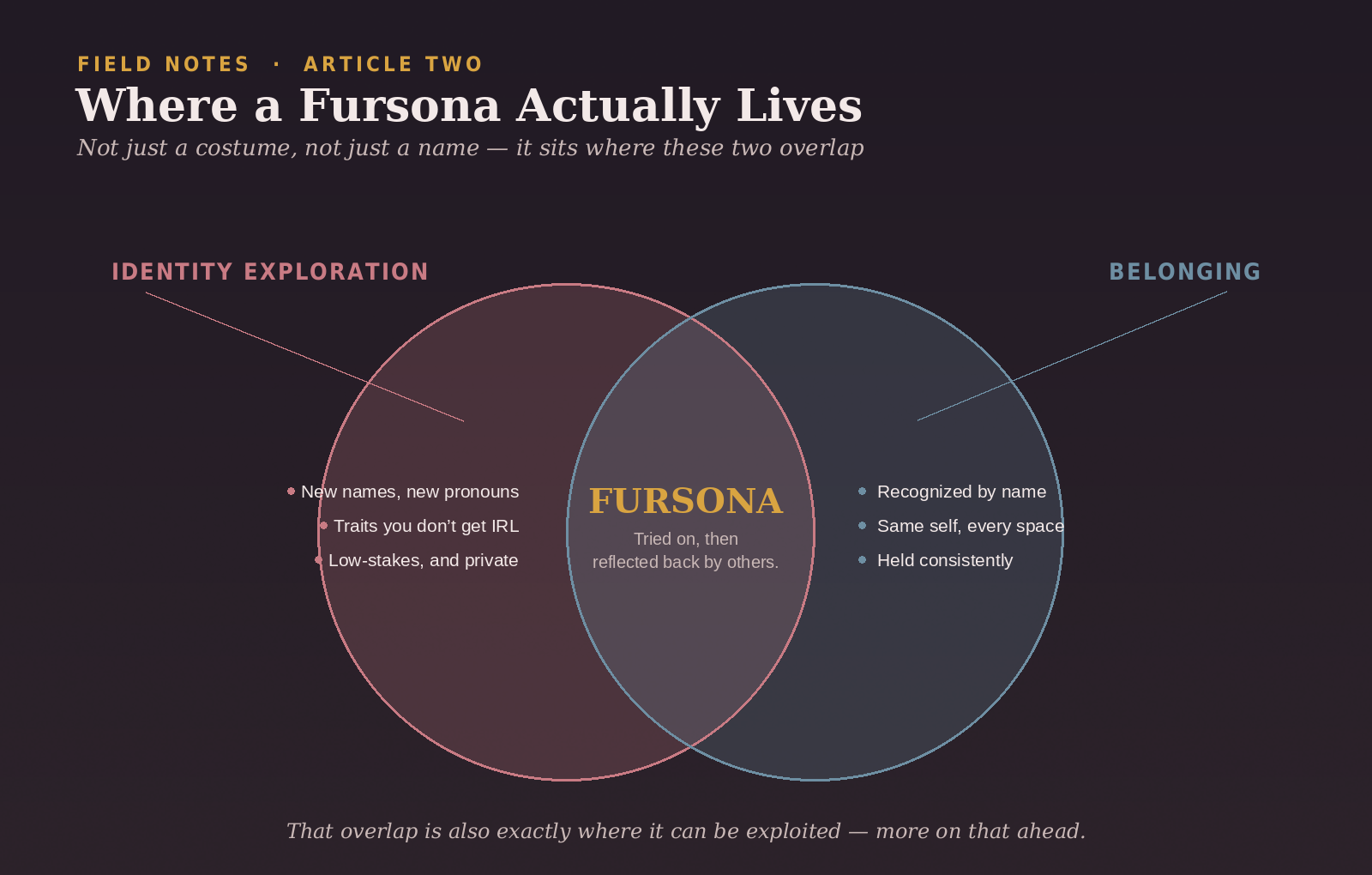
Why a fursona can feel safer than a biography
A real-world introduction carries inherited information:
- Face
- Body
- Voice
- Age assumptions
- Gender assumptions
- Disability visibility
- Race and cultural cues
- Clothing
- Class signals
- Past reputation
A fursona begins with choice.
A person can choose:
- Species
- Name
- Colors
- Shape
- Gender expression
- Clothing
- Voice
- Backstory
- Abilities
- Emotional tone
- Social role
That creative control can be ordinary artistic pleasure. For someone whose identity has been mocked, controlled, or misunderstood, it can also feel unusually significant.
Research on furry costuming and identity exploration has described how dressing and as-animal performance can support safe exploration, expression, and negotiation of identity. An ethnographic study of LGBT+ furries likewise described online furry spaces as places where participants could explore non-normative identities and belonging.
A fursona does not erase the person.
It may function as:
- A magnifier of desired traits
- A rehearsal space
- A protective layer
- A social introduction
- A creative project
- A symbol of continuity
- A way to be seen before being fully exposed
The important question is not whether the fursona is “the real self.”
The important question is what the relationship with the character allows the person to express, practice, or understand.
Avatars provide distance and presence at the same time
VRChat and other avatar spaces create a strange combination: distance from the physical body and increased social presence.
A person can:
- Enter from home
- Control the camera
- Mute
- Leave instantly
- Change avatars
- Choose a voice setting
- Sit without being watched physically
- Communicate through gesture
- Join a private instance
- Explore appearance without permanent consequences
At the same time, they can experience:
- Eye contact
- Proximity
- Dancing
- Shared environments
- Body language
- Group ritual
- Recognition
- Real-time laughter
- Emotional intimacy
For someone who finds ordinary social spaces threatening, that balance can feel revolutionary.
The VRChat furry pup community guide explains how avatars, groups, instances, and events become community infrastructure. The trauma-informed addition is this: control over entry, exit, identity, and visibility can reduce the cost of trying.
That does not make VR automatically safe. Harassment, boundary violations, doxxing, manipulation, and sudden exclusion can be intensified when the avatar space carries a person’s main social life.
Play can restore something without recreating childhood
Adults play.
They dance, roleplay, wear costumes, collect plush toys, make animal noises, create characters, watch cartoons, cuddle, joke, and build imaginary worlds.
None of those behaviors automatically indicate regression or trauma.
For some people, play may provide:
- Relief from constant seriousness
- Sensory comfort
- Permission to be expressive
- Nonverbal connection
- A break from professional roles
- A way to practice trust
- Joy without productivity
- Creativity without evaluation
Pup and furry spaces sometimes use softness, affection, canine mannerisms, gear, or pack language. The furry pup, pup play, and pet play explainer distinguishes overlapping communities without treating them as interchangeable.
A trauma-informed approach does not ask, “What happened to make you act like this?”
It asks, “What does this expression mean to you, and what boundaries apply here?”
Chosen family can be powerful because belonging was once uncertain
People use “chosen family” to describe relationships built through mutual care rather than biology.
In furry spaces, chosen family may include:
- Close friends
- Partners
- Pack members
- Convention roommates
- Creator collaborators
- Moderators
- Gaming circles
- VRChat groups
- Local furmeet communities
FurScience reports that furries often seek and receive emotional support, advice, and guidance from specific people within the fandom. Its research describes reciprocal helping, where people who have received help may later help others.
Research across furries and other fandoms has also linked ingroup helping with self-esteem and psychological well-being.
This is one of the fandom’s strongest possibilities:
A person who once believed they were fundamentally strange may discover that their traits are understandable, shareable, and even loved.
Chosen family can also become dangerous when the phrase is used to skip normal trust development.
“Family” should not mean:
- Immediate access to private information
- Unlimited emotional labor
- Financial obligation
- Pressure to forgive
- Permission to ignore boundaries
- Loyalty to one leader
- Isolation from outside relationships
- Secrecy around harmful behavior
Healthy chosen family is chosen continuously.
Online connection matters because the fandom is geographically scattered
FurScience data emphasizes that much furry interaction occurs online and that many furries do not live in the same city as most of the furries they know.
That distributed structure creates opportunity.
A person in a rural area may find:
- LGBTQ+ peers
- Other disabled creators
- People with the same species interest
- Artists who understand their character
- A VRChat group
- A convention roommate
- A language community
- A pup social
- Friends awake at the same unusual hours
The same structure creates vulnerability.
If a person’s support network is concentrated in one server, one breakup or ban can remove nearly every friend at once. If a person’s identity exists mainly through one account, doxxing or account loss can feel like social erasure.
The solution is not to dismiss online friendship as unreal. It is to build redundancy:
- More than one trusted relationship
- More than one platform
- Offline contact where safe
- Professional support when needed
- Private backups of important creative work
- Interests outside one community
- Personal routines that survive server conflict
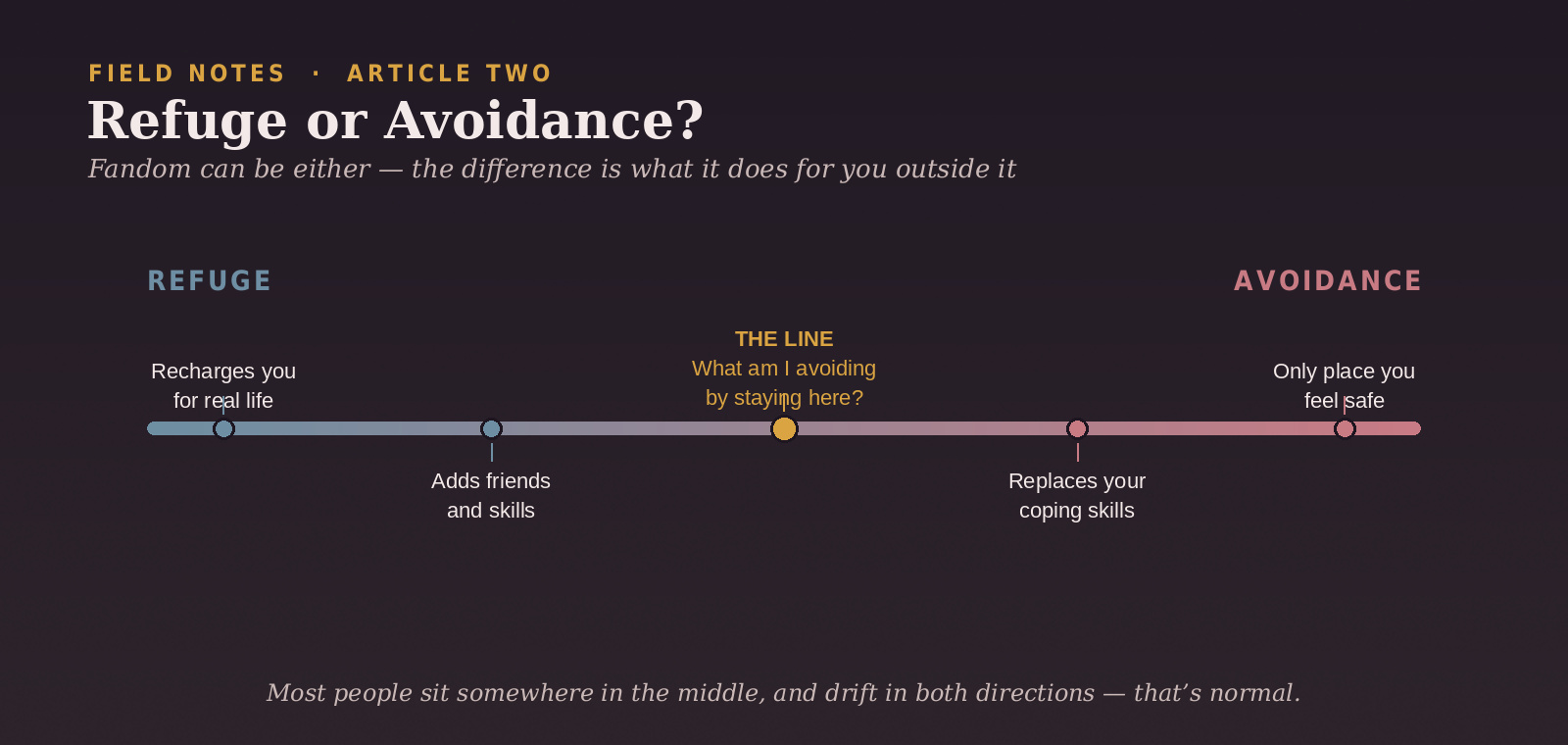
Escape is not automatically avoidance
The word escape carries a moral judgment.
People escape into:
- Books
- Games
- Music
- Art
- Exercise
- Travel
- Work
- Fandom
- Spirituality
- Sleep
- Social media
Temporary psychological distance can help regulate emotion and restore energy.
The question is whether escape returns someone to life with more capacity or steadily replaces the parts of life that require care.
Restorative refuge
A restorative fandom experience may:
- Reduce stress for a while
- Support creativity
- Produce real friendship
- Increase confidence
- Encourage healthy routines
- Help someone name an identity
- Create motivation
- Provide mutual aid
- Lead to offline participation
- Coexist with work, sleep, treatment, and responsibilities
Avoidance-driven escape
An avoidance pattern may:
- Replace necessary medical or mental-health care
- Consume sleep
- Increase financial instability
- Make every offline task feel intolerable
- Depend on constant validation
- Intensify panic when the server is quiet
- Prevent difficult but necessary conversations
- Concentrate all support in one person
- Turn avatar life into the only acceptable self
- Continue despite clear harm
Research on gaming escapism suggests that coping motivation can be adaptive in some contexts but becomes more concerning when tied to emotion-regulation difficulties, disengaged coping, and problematic use.
The same principle can guide fandom without pathologizing it:
Refuge helps you breathe. Avoidance makes breathing possible only inside the refuge.
The face of trauma can appear in community behavior
Trauma responses are individual, but communities may repeatedly encounter certain patterns.
Hypervigilance
A person may scan tone, status changes, private channels, and pauses for signs of danger.
A delayed reply may feel like abandonment. A moderator joining a voice channel may feel like punishment. A vague post may feel personally targeted.
Fawning
A person may over-agree, overhelp, apologize constantly, or accept uncomfortable behavior to preserve connection.
This can make them appear endlessly generous while resentment quietly accumulates.
Flight
A person may leave servers, delete accounts, or disappear during conflict.
Exit can be a healthy boundary. Repeatedly abandoning every relationship before clarification may also protect against vulnerability at a high social cost.
Freeze
A person may become unable to answer, report, decide, or explain during pressure.
Silence should not automatically be interpreted as guilt, consent, or indifference.
Fight
A person may respond to perceived threat with anger, public defense, rapid accusations, or attempts to regain control.
Trauma context can explain intensity. It does not excuse threats, harassment, doxxing, or retaliation.
The goal is not to label members with a response type. It is to create processes that do not require perfect calm in order to be treated fairly.
Why fandom conflict can reopen older wounds
A server dispute may resemble an earlier experience:
- Being excluded at school
- Family rejection
- A controlling relationship
- Public humiliation
- Being disbelieved
- Losing housing
- Being outed
- Being punished for identity
- Having privacy violated
The present event may activate the emotional meaning of the past.
That can create a mismatch between the visible event and the experienced threat.
A friend may think:
“It was only a role removal.”
The affected person may experience:
“Every place I become visible eventually decides I am disposable.”
Both statements describe different layers.
A fair community addresses the current behavior without mocking the deeper reaction. The fake friends and community division guide explains how coordinated exclusion can collapse several social supports at once.
Trauma-informed does not mean consequence-free
This point is essential.
A trauma history does not authorize:
- Harassment
- Threats
- Doxxing
- Manipulation
- Coercion
- Stalking
- Repeated privacy violations
- Unsolicited explicit content
- Abuse of moderator tools
- Financial exploitation
Trauma-informed practice changes how a community responds.
It favors:
- Clear expectations
- Predictable consequences
- Private communication
- Choice where possible
- Explanation
- Proportionate action
- Recusal
- Appeals
- Avoidance of humiliation
- Support resources
- Attention to power
It does not require a community to preserve access when someone remains dangerous.
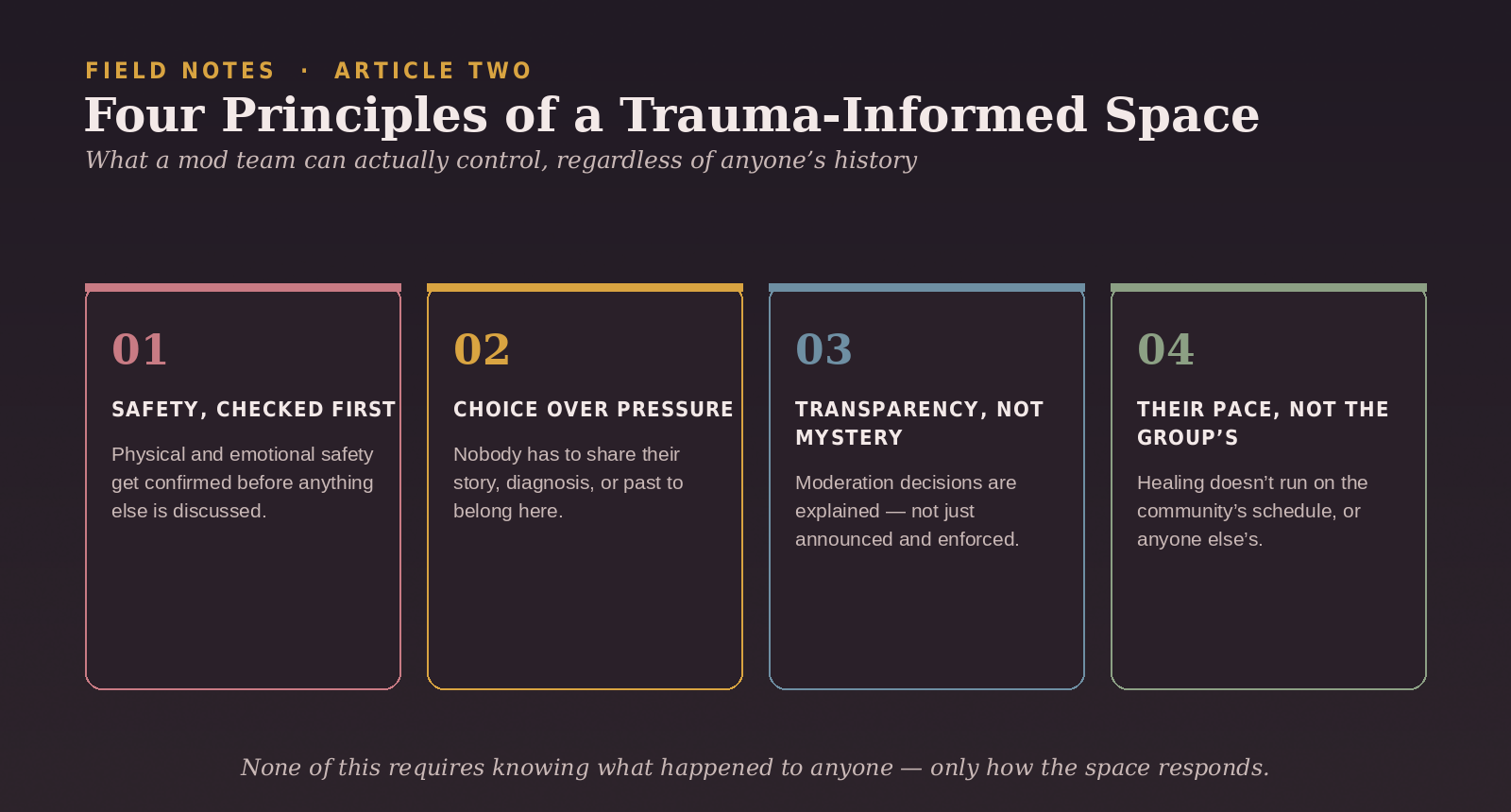
Six trauma-informed principles for furry communities
SAMHSA’s trauma-informed framework is commonly summarized through safety, trustworthiness and transparency, peer support, collaboration, empowerment and choice, and responsiveness to cultural and identity contexts.
A furry community can translate those ideas without pretending to be a clinic.
Physical and psychological safety
Members should know:
- What content is allowed
- Who can enter
- How recording works
- How to leave
- How to block
- How to report
- Which staff are present
- What happens after a report
VRChat events need visible exits, private-instance options, and staff contacts. Discord spaces need clear channel purposes, privacy limits, and permission boundaries.
Trustworthiness and transparency
Communities should publish:
- Rules
- Verification expectations
- Data handling
- Moderation steps
- Conflict-of-interest rules
- Appeal options
- Policy changes
- Creator permissions
The Mello Zone transparency page and Community Manifesto aim to make expectations visible before trust is requested.
Peer support without amateur diagnosis
Peers can offer:
- Listening
- Company
- Practical help
- Resource links
- Shared experience
- Encouragement
- Accountability
Peers should not:
- Diagnose
- Prescribe
- Promise cures
- Demand disclosure
- Handle emergencies alone
- Become the only support person
- Treat personal experience as universal
Collaboration and mutuality
Members should have meaningful ways to influence:
- Event design
- Accessibility
- Rules
- Creator programs
- Community resources
- Feedback systems
Collaboration does not mean every decision is a vote. It means power is explained and feedback has a real route.
Empowerment, voice, and choice
Members should be able to:
- Decline hugs
- Decline DMs
- Leave an event
- Use a different avatar
- Avoid recording
- Request a different reviewer
- Appeal
- Participate without disclosing trauma
- Belong without performing vulnerability
A community becomes unsafe when pain is the entry fee for care.
Cultural, historical, identity, and gender awareness
Furry communities often include LGBTQ+ people, disabled people, neurodivergent people, veterans, people of different races and cultures, immigrants, and members from several countries.
One communication style cannot be treated as universally healthy. Policies should consider:
- Language
- Pronouns
- disability access
- religious and cultural context
- privacy risks
- legal differences
- identity-based harassment
- historical mistrust of institutions
The dedicated You Matter publication gives members mental-health, LGBTQ+, crisis, and everyday-support options beyond community staff.
When a refuge becomes too responsible for one person
A community becomes fragile when it is expected to provide:
- Every friendship
- Every relationship
- Therapy
- Crisis response
- Housing
- Income
- Identity validation
- Entertainment
- Creative purpose
- Conflict resolution
- Family replacement
No volunteer server can safely carry all of that.
Warning signs include:
- Panic whenever friends are offline
- Remaining in harmful relationships to preserve group access
- Spending money needed for essentials
- Missing medication, sleep, work, or school
- Treating moderators as therapists
- Refusing professional help because “the pack understands me”
- Feeling unable to exist without an avatar
- Repeatedly moving to new groups without addressing the same conflict pattern
The answer is not to abandon fandom. It is to widen the support structure.
A layered support system is stronger than one perfect server
A sustainable support map can include:
Personal regulation
- Sleep
- Food
- Medication
- Movement
- Time offline
- Creative activity
- Sensory tools
- Journaling
- Spiritual or cultural practices
Trusted relationships
- One or two close friends
- Family where safe
- A partner
- A mentor
- A peer-support group
- Friends outside the fandom
Professional care
- Therapist
- Psychiatrist
- Primary-care clinician
- Support group
- Crisis counselor
- Case manager
Community participation
- Discord
- VRChat
- Local furmeets
- Conventions
- Art groups
- Gaming circles
- Creator projects
Each layer has a different job.
A friend can sit with pain. A clinician can assess symptoms. A moderator can enforce rules. A crisis counselor can respond in an urgent moment. A community can provide belonging.
Problems begin when one role impersonates all the others.
How to support a friend without becoming their therapist
Ask what kind of support they want
Use:
“Do you want listening, practical help, distraction, or help finding a resource?”
That question restores choice.
Keep your promises realistic
Do not say:
- “I will always be available.”
- “I will never leave.”
- “You only need me.”
- “I can fix this.”
Use:
- “I can stay for the next twenty minutes.”
- “I can help you find the support page.”
- “I care, and I am not trained for this emergency.”
- “Let us contact someone equipped to help.”
Do not demand the full story
A person can request support without proving trauma through graphic detail.
Respect privacy with safety limits
Do not casually share disclosures. Do not promise absolute secrecy when someone describes an immediate danger to themselves or another person. In urgent situations, involve an appropriate crisis or emergency service.
Protect your own capacity
Supporting someone does not require accepting abuse, sleep deprivation, financial pressure, or constant crisis access.
Boundaries preserve care.
How fandom can support healing without claiming to heal
A fandom can provide conditions that support resilience:
- Consistent friendship
- Creative mastery
- Play
- Shared identity
- Mutual aid
- Opportunities to help others
- Recognition
- Safe experimentation
- Community ritual
- Meaning
Research on helping across fandoms suggests that intragroup helping can help explain links between fandom identification, self-esteem, and well-being. A 2026 cultural psychiatry review also highlights how furry social relationships and support may contribute to resilience for some people experiencing mental-health difficulties.
Those are meaningful benefits.
They do not make furry fandom a treatment protocol.
A convention cannot promise recovery. A fursona cannot diagnose a condition. A Discord server cannot safely replace a clinician. A moderator cannot be expected to manage suicidal crisis alone.
The responsible claim is smaller and stronger:
Fandom can become one supportive environment in a larger life.
What Mello Zone is trying to build
Mello Zone’s 18+ SFW model is not based on the belief that every member is wounded.
It is based on the recognition that people enter communities with different histories, boundaries, identities, and levels of trust.
The goal is to make belonging easier through:
- Public rules
- Clear age expectations
- SFW shared spaces
- Private reporting
- Appeals
- Creator consent
- DM boundaries
- Resource directories
- VRChat and Discord safety
- Transparent policy
The Mello Zone Furry Community Guide explains the broader vision: people should not need a fursuit, perfect avatar, creator following, or finished identity before they are allowed to participate.
A trauma-informed community does not ask everyone to disclose their past.
It builds a space where disclosure is not required for dignity.
When to seek support beyond fandom
Consider outside support when distress:
- Persists
- Interferes with sleep or work
- Produces panic or intrusive memories
- Leads to self-harm thoughts
- Makes relationships feel impossible
- Drives substance misuse
- Creates unsafe behavior
- Makes daily functioning difficult
The You Matter mental-health resource directory includes crisis, treatment-referral, text, education, and peer-support options. In the United States, its 988 Suicide and Crisis Lifeline profile provides the current official call, text, and chat paths for suicidal crisis or emotional distress.
Mello Zone is not a crisis center or healthcare provider. Community support and professional help can work together.
Key takeaways about trauma and furry fandom
- Furry participation is not evidence of trauma.
- Research does not support saying most furries share one traumatic past.
- Some people with histories of rejection, isolation, stigma, or harm may find unusual value in creative identity and online belonging.
- Fursonas and avatars can support exploration, expression, distance, and agency without being symptoms.
- Online furry communities can provide real emotional support and reciprocal helping.
- Escape can be restorative when it returns capacity to life.
- Escape becomes risky when it replaces care, sleep, responsibilities, offline support, or every other identity.
- Trauma-informed community design emphasizes safety, transparency, peer support, collaboration, choice, and cultural awareness.
- Trauma context can explain behavior without excusing harm.
- Moderators are not therapists.
- A fandom can be a refuge without becoming the only place a person can survive.
FAQ about trauma, escape, and furry belonging
Are most furries traumatized?
There is no solid evidence supporting that claim. Furries enter the fandom for many reasons, including art, animals, creativity, friendship, games, performance, technology, and identity exploration.
Is a fursona a trauma response?
Not inherently. A fursona is commonly a creative character, identity tool, social representation, or artistic project. It may hold personal meaning, but its existence does not reveal a diagnosis or history.
Is escapism always unhealthy?
No. Temporary escape can provide rest, perspective, creativity, and emotional regulation. It becomes concerning when it consistently replaces necessary care, responsibilities, relationships, or offline functioning.
Can online furry friendships provide real support?
Yes. Research on furry interaction and helping describes emotional support, advice, guidance, and reciprocal assistance within the fandom. Online support is still strengthened by diversity, boundaries, and outside resources.
Why can a server ban feel devastating?
A ban may remove several supports at once, including friends, routine, identity, events, creator opportunities, and emotional belonging. The intensity does not prove the decision was wrong, but it explains why fair process and careful communication matter.
Should moderators use trauma-informed practices?
Yes, as an organizational approach to safety, transparency, choice, and non-humiliating process. That does not turn moderators into clinicians or require them to tolerate dangerous behavior.
How can I help a traumatized friend?
Listen, ask what support they want, respect privacy, encourage professional resources, avoid diagnosing, and maintain realistic boundaries. In an immediate crisis, connect them with an appropriate crisis or emergency service.
Can someone heal through fandom alone?
Fandom may support resilience, identity, friendship, and meaning. It should not be treated as a complete substitute for professional care when someone needs assessment, treatment, or crisis support.
Why this article exists
The Mello Zone contribution: Mello Zone brings community observation to trauma research without diagnosing the fandom, distinguishing refuge, creative identity, peer support, boundaries, and safer belonging from the false claim that trauma defines furries.
by Mello Zone Editorial Team.
Created a trauma-informed, research-based guide on why some people experience furry fandom as refuge, identity space, peer support, and creative escape, while rejecting the unsupported claim that most furries share a trauma history. Corrected the image alternative text to describe the displayed artwork; reporting and source-review dates are unchanged.
Read our sourcing, AI-assistance, and corrections policy.
Source links recorded for this article
- SAMHSA overview of trauma and its effects
- SAMHSA trauma-informed approaches
- Helping in the furry fandom
- Furry social interaction research
- Furry involvement as a coping resource
- LGBT+ furry identity formation and belonging online
- Furry fandom and identity exploration through dress
- Fandom helping, self-esteem, and well-being
- Fan cultures and mental health
- Escapism and problematic gaming research