
Editorial scope: “Fake friend” is not a diagnosis. It is common language for a relationship that performs care while repeatedly using closeness for status, access, information, leverage, or control. This article does not identify any individual, settle a private dispute, or turn ordinary incompatibility into abuse. It examines patterns, consequences, boundaries, and repair.
A community is not proven by how often people say the word community. It is proven by what happens when attention is scarce, conflict arrives, a friend becomes inconvenient, or someone no longer benefits the inner circle.
That is where fake friendship becomes visible.
A person may call everyone family while privately sorting people into useful, disposable, and threatening categories. A group may advertise inclusion while using loyalty tests, private rumor channels, selective screenshots, and social punishment to keep members obedient. A leader may apologize beautifully, regain access, and then repeat the same choices once the immediate pressure fades.
The contradiction matters:
People cannot credibly claim to protect community while repeatedly using division as a tool of control.
People can ask for forgiveness. Nobody can demand reconciliation while continuing the behavior that made repair necessary. An apology can open the door to accountability, but changed conduct is what proves someone actually walked through it.
This is not an argument against boundaries. Healthy communities sometimes separate people, restrict access, remove harmful actors, create specialized spaces, or pause contact. The issue is why separation happens, how it happens, and what it does to everyone left behind.
Community is a practice, not a branding word
“Community” is often used as a moral shield.
Someone says:
- “We are protecting the community.”
- “We are keeping the peace.”
- “We are only looking out for our friends.”
- “We had to choose a side.”
- “They are not one of us anymore.”
Sometimes those statements describe necessary safety action. Sometimes they disguise a smaller truth: the speaker is protecting a clique, reputation, relationship, or source of status.
A real community can contain disagreement without converting every disagreement into exile. It can set rules without inventing evidence. It can remove someone for documented harm without demanding that every mutual friend participate in a public ritual of hatred. It can defend a boundary without rewriting the target into a monster.
The Mello Zone Community Manifesto draws the necessary distinction between protecting people from harmful behavior and punishing harmless difference. That line becomes especially important in fandom spaces where identity, friendship, art, business, romance, moderation, and public reputation overlap.
A community is healthier when it can answer:
- What behavior happened?
- What rule or boundary applies?
- What evidence supports the decision?
- What response is proportionate?
- Is there a review or appeal path?
- Are private details being protected?
- Is the action about safety, or about loyalty?
When those questions disappear, “community protection” can become a costume worn by social control.
What fake friendship looks like in online fandom
Fake friendship is not simply a friendship that ends.
People grow apart. Interests change. Misunderstandings happen. Two decent people can become incompatible. A friend may lack the capacity to support someone during a crisis without secretly hating them. None of those situations automatically means the relationship was fraudulent.
The warning signs appear when closeness is repeatedly used as an instrument.
Transactional closeness
A transactional friend is warm while access is useful.
They may value:
- Your server role
- Your audience
- Your art
- Your event contacts
- Your technical skills
- Your home or transportation
- Your emotional labor
- Your information
- Your proximity to someone they want
The relationship becomes colder when the benefit stops. Requests flow one direction. Care arrives mainly when the friend fears losing access.
Community creators are especially vulnerable because collaboration can look like intimacy. A person may spend hours in calls, share private fears, and use affectionate language while primarily viewing the relationship as a bridge to followers, events, or status.
Information harvesting
Some people build closeness by inviting disclosure, then treat private information as future currency.
They collect:
- Screenshots
- Confessions
- Relationship details
- Mental-health disclosures
- Staff disagreements
- Financial struggles
- Private criticism
- Old mistakes
The information may remain hidden until conflict begins. Then the archive becomes a weapon, often stripped of context and released in the order most likely to control the story.
Healthy friends do not require perfect secrecy forever. Serious safety concerns may need to be reported. The difference is purpose and proportion. Reporting a credible threat through a protected channel is not the same as releasing a vulnerable disclosure to win an audience.
Triangulation
Triangulation occurs when one person manages conflict through third parties instead of addressing the relevant person directly.
It can sound like:
- “Everyone is worried about you.”
- “People are saying things, but I cannot name them.”
- “I am only telling you because I care.”
- “You need to prove where your loyalty is.”
- “Do not tell them I showed you this.”
The method creates uncertainty. Nobody knows who said what. The person at the center gains control because they become the only apparent route between groups.
Triangulation is a community splitter. It turns ordinary questions into secret alliances and makes direct clarification look like betrayal.
Selective empathy
A fake friend may treat pain as valid only when it supports their preferred side.
They may demand sensitivity for their own triggers while mocking another person’s fear. They may condemn public callouts when aimed inward, then celebrate them when aimed outward. They may insist that context matters for friends and that context is an excuse for enemies.
Selective empathy trains members to understand that dignity is conditional.
Audience friendship
Online communities can produce a performance of friendship aimed at spectators.
Publicly, the relationship may include:
- Affectionate comments
- Matching profile language
- Collaborative posts
- Public defense
- “Found family” declarations
- Constant tagging
Privately, there may be contempt, competition, pressure, or neglect.
The visible bond becomes part of both people’s brands. Ending it then threatens not only the relationship but the social story surrounding it. That pressure can make honest disagreement feel commercially dangerous.
Why betrayal and exclusion feel physically urgent
Social exclusion is not experienced as a tidy intellectual disagreement.
Psychological research on ostracism and rejection describes threats to fundamental needs such as belonging, self-esteem, control, and meaningful recognition. Brief exclusion can produce sadness, anger, and distress. Repeated or chronic exclusion can wear down coping resources.
In an online furry community, exclusion may involve:
- Being removed from shared servers
- Losing a group role
- Watching friends stop replying
- Being excluded from events
- Being blocked by several people at once
- Seeing private details circulated
- Losing customers or collaborators
- Being treated as dangerous without being told why
The practical and emotional losses arrive together.
A person does not only lose one friendship. They may lose:
- Their evening routine
- Their VRChat group
- Their gaming circle
- Their creator network
- Their convention roommates
- Their emotional support
- Their sense of identity
- Their place to be known
That explains why community betrayal can produce disproportionate-seeming reactions. The event may be one server ban, but the nervous system reads the collapse of an entire social map.
This does not prove that every excluded person is innocent. It means communities should understand the weight of coordinated exclusion and use it carefully.
Relational aggression hides behind social normality
Relational aggression harms someone through relationships and social position rather than direct physical force.
Research on relational aggression in young adult friendships includes behaviors shaped by exclusivity, relationship norms, and indirect social pressure. In fandom spaces, similar mechanisms may appear as:
- Threatening to withdraw the whole friend group
- Punishing people for neutral contact with an outgroup
- Spreading rumors through private messages
- Coordinating blocks
- Excluding someone from events without explanation
- Using moderator tools during personal conflict
- Turning access to friends into a reward
- Making public affection conditional on obedience
These actions can remain socially deniable.
The aggressor can say:
- “Nobody owes anyone friendship.”
- “People made their own decisions.”
- “It was only a private conversation.”
- “We are allowed to curate our space.”
Each sentence can be true by itself. The pattern may still be coercive when many “independent choices” were produced by one rumor pipeline, loyalty demand, or threat of social consequence.
Not every separated space is a divided community
A crucial distinction is the difference between protective separation and destructive division.
Protective separation
Protective separation may include:
- Removing someone after credible threats
- Restricting access during an investigation
- Creating an age-gated space
- Separating SFW and adult content
- Providing an identity-specific support group
- Giving two people a cooling-off period
- Recusing a moderator from a personal case
- Blocking direct contact after harassment
The purpose is safety, consent, function, or recovery.
Protective separation should be:
- Narrow
- Documented where appropriate
- Proportionate
- Reviewable
- Private when possible
- Focused on behavior
- Free from unnecessary humiliation
Destructive division
Destructive division may include:
- Demanding that friends choose sides
- Punishing neutral contact
- Creating blacklists without process
- Using rumors as proof
- Expanding a private dispute into a community identity war
- Treating questions as disloyalty
- Recruiting newcomers into old conflicts
- Repeating accusations after they were corrected
- Using moderation powers to settle personal scores
The purpose is often dominance, emotional vindication, status protection, or narrative control.
The difference is not whether someone was excluded. It is whether the process reduces harm or manufactures more of it.
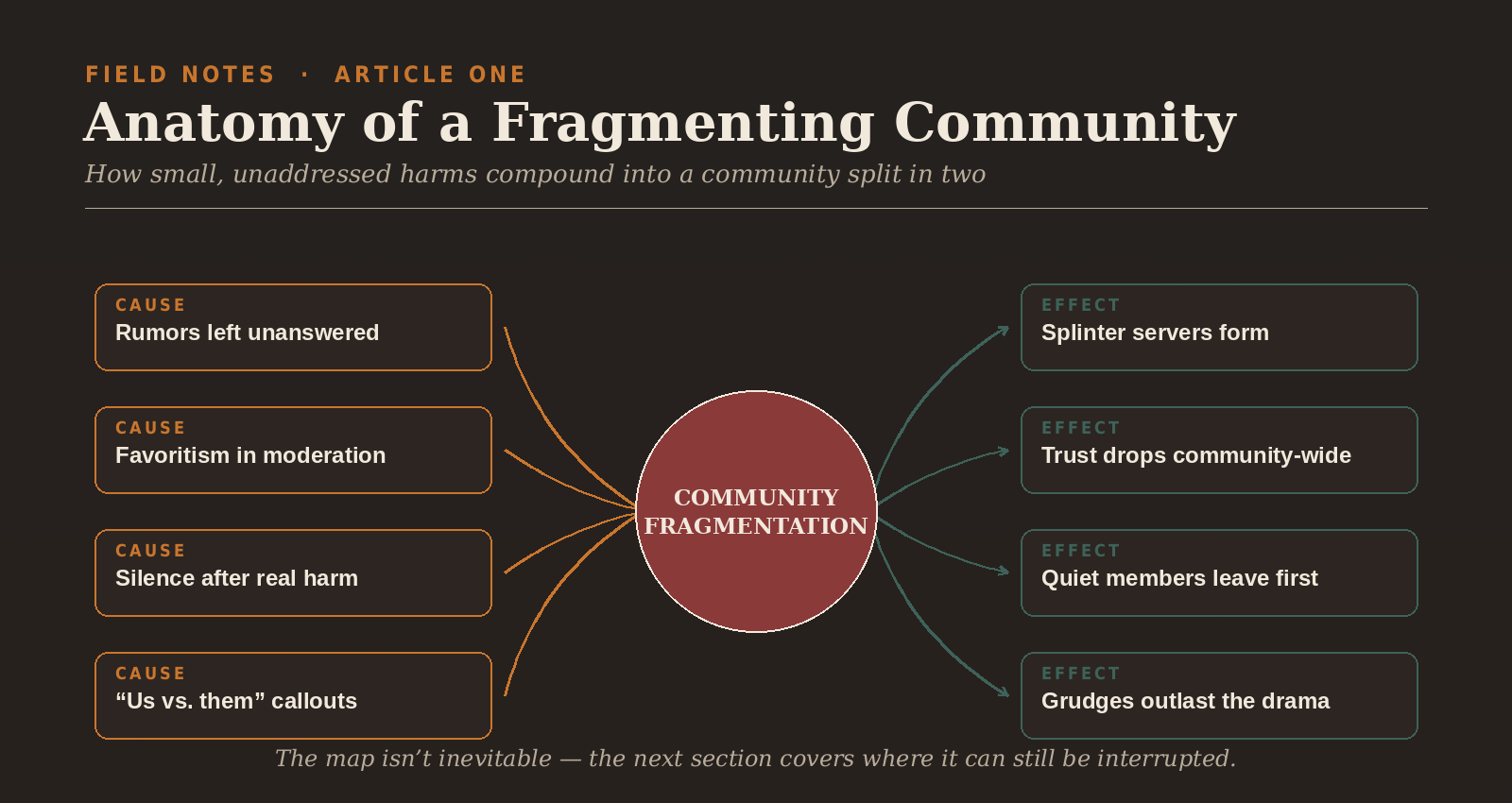
The cause-and-effect chain of community fragmentation
Community splits rarely begin with one dramatic explosion. They often grow through a chain.
| Cause | Immediate effect | Wider community impact |
|---|---|---|
| Private frustration is never addressed | Resentment builds | Neutral behavior is interpreted as hostile |
| One person becomes the information broker | Triangulation increases | Members lose access to direct context |
| Screenshots replace conversation | Nuance collapses | People judge fragments rather than events |
| Loyalty becomes a test | Friends perform allegiance | Cross-group relationships become dangerous |
| Blocks are coordinated | Social exclusion accelerates | The target loses several support ties at once |
| Public claims outrun evidence | Reputation hardens | Corrections reach fewer people than accusations |
| Apologies restore access without repair | Consequences disappear | The same conduct becomes more likely to repeat |
| Members stop reporting concerns | Silence looks like peace | Harm moves into private channels |
| Creators and volunteers withdraw | Capacity shrinks | The remaining clique gains more control |
| New groups form around old conflict | Fragmentation becomes permanent | Every future disagreement reactivates the split |
This is why “drama” is too small a word for some community conflicts. The real product can be a damaged information system, weakened moderation, displaced members, and a culture where people learn that speaking honestly is expensive.
How groups begin treating division as loyalty
People naturally form ingroups.
Research has even found ingroup favoritism inside the furry fandom, including preferences linked to fursona-species identification. That does not mean furries are uniquely tribal. It shows that ordinary social identity processes can appear even inside a fandom built around difference.
Group identity can provide:
- Safety
- Shared language
- Humor
- Pride
- Mutual aid
- Predictability
- Defense against outside stigma
The same identity can distort perception when the group’s status feels threatened.
Then:
- A friend’s mistake becomes understandable.
- An outsider’s mistake becomes evidence of character.
- A friend’s apology becomes brave.
- An outsider’s apology becomes manipulation.
- A friend’s privacy is sacred.
- An outsider’s privacy becomes optional.
- A friend’s growth is assumed.
- An outsider’s growth is treated as impossible.
Online discussion can reinforce group boundaries. Research on Twitter debate and group polarization found that like-minded interaction can strengthen group identity, while interaction across opposing groups can reinforce ingroup and outgroup affiliation. A later online discussion experiment also shows that group membership can shape willingness to speak and how people express opinions.
The lesson is not that mixed groups automatically heal conflict. The lesson is that a closed social loop can make its own interpretation feel like obvious reality.
What fragmentation does to the person who is targeted
The individual impact can include:
- Hypervigilance about messages and status changes
- Re-reading old conversations
- Fear of new friendships
- Shame
- Anger
- Sleep disruption
- Difficulty concentrating
- Compulsive checking
- Withdrawal from events
- Loss of creative motivation
- Distrust of moderators
- Overexplaining
- Attempts to contact people who asked for distance
Some reactions can unintentionally worsen the situation. A frightened person may send too many messages, demand immediate answers, or post publicly before thinking. Those actions still require accountability, but they may emerge from panic rather than a calculated plan.
A trauma-informed community does not excuse harmful behavior. It responds without unnecessary escalation. SAMHSA’s trauma-informed framework emphasizes safety, trust, collaboration, empowerment, and resistance to retraumatization. Those ideas can improve moderation even when nobody is being clinically diagnosed.
What fragmentation does to bystanders
Bystanders often believe they are uninvolved. They still absorb the effects.
They may experience:
- Pressure to take sides
- Fear that neutrality will be punished
- Confusion about what is true
- Guilt for staying connected to both people
- Anxiety about private messages being leaked
- Reluctance to form close friendships
- Cynicism about community language
- Emotional fatigue
A bystander may join a block campaign simply to avoid becoming the next target. Another may remain silent because they fear social punishment. Another may defend a friend despite doubts because the group has made uncertainty feel immoral.
That is how division reproduces itself without every participant intending harm.
What fragmentation does to newcomers
Newcomers arrive without the history.
They see:
- Vague warnings
- Old callout documents
- Missing context
- Friends who refuse to name the issue
- Rules that seem to apply differently by social rank
- Several groups claiming to be the only safe one
The newcomer learns the culture through conflict.
If belonging requires inheriting an enemy list, the group is not onboarding members into community. It is recruiting them into a feud.
A healthier entry path is explained in the guide to joining a furry pup community safely: observe, verify, protect private information, and let trust grow through repeated behavior rather than instant intimacy.
What fragmentation does to creators and volunteers
Creators lose more than companionship when a community splits.
They may lose:
- Commissions
- Collaborators
- Event invitations
- Moderation support
- Shared assets
- Audience trust
- Access to promotional channels
- Housing or travel plans
- Emotional energy needed to create
Volunteers may leave because every administrative action is interpreted through factional loyalty. Moderators may burn out from reviewing interpersonal disputes that have expanded into public campaigns. Event hosts may cancel rather than risk importing the conflict.
The community then becomes smaller and less capable, which can increase the influence of the remaining inner circle.
An apology is not the same as repair
Apologies matter.
Experimental research on apology and restitution found that thorough apology and restitution can reduce unforgiving motivations and support empathy and forgiveness. The important detail is that apology appears alongside responsibility and repair.
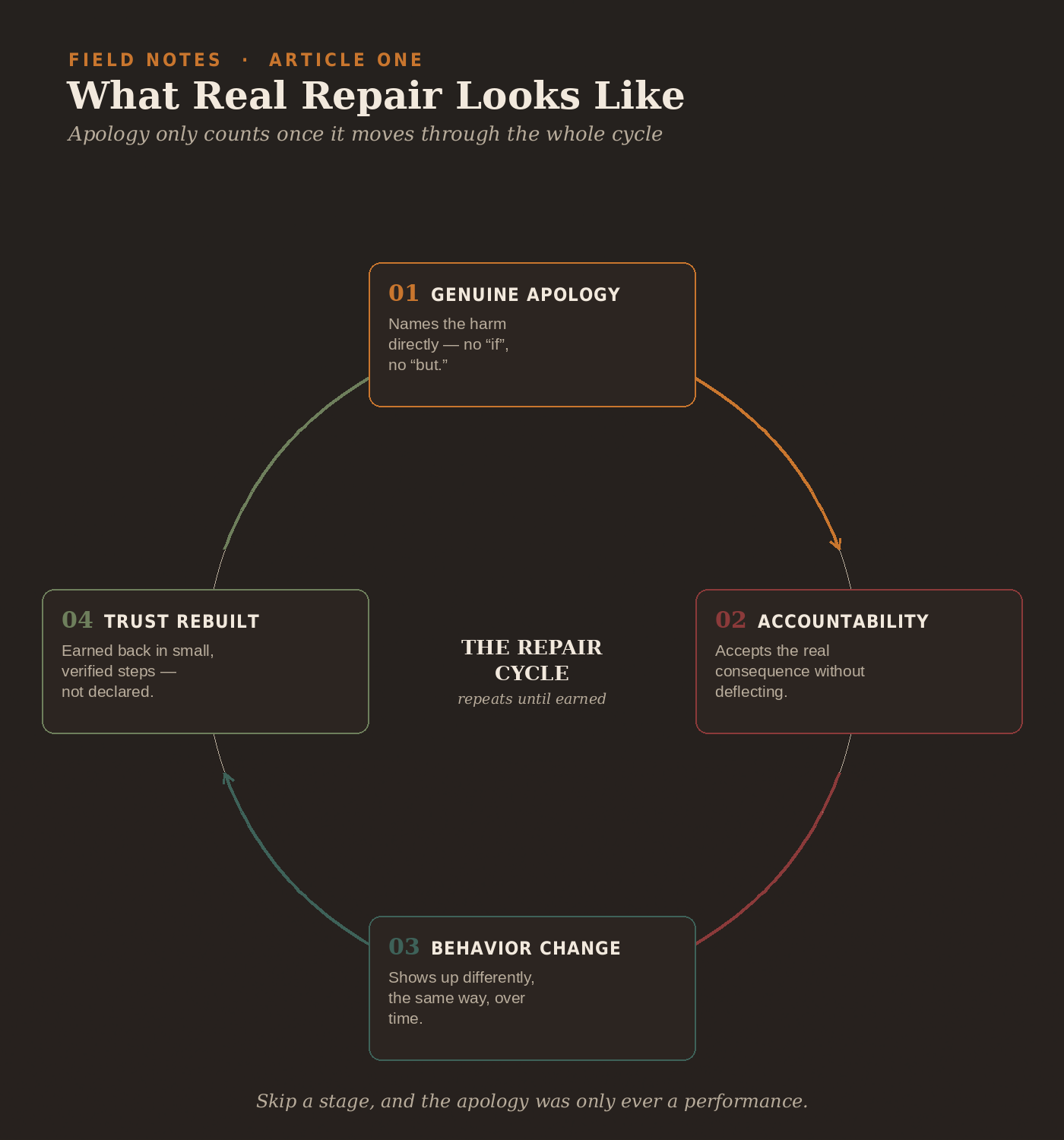
A credible apology includes:
- A clear description of what happened.
- Ownership without hiding behind intention.
- Recognition of the impact.
- No demand that the harmed person comfort the apologizer.
- A repair action where possible.
- A plan to prevent repetition.
- Acceptance that trust may return slowly or not at all.
- Changed behavior over time.
An apology fails when it exists mainly to restore the apologizer’s comfort, access, image, or authority.
Examples include:
- “I am sorry you felt hurt.”
- “I already apologized, so you need to move on.”
- “I was triggered, therefore I am not responsible.”
- “Both sides made mistakes,” when one specific action is being addressed.
- “I have changed,” without naming any change.
- “I forgive myself,” used to bypass consequences.
- “We are family,” used to pressure renewed contact.
An apology can be sincere and still be insufficient. Sincerity describes a feeling. Repair describes a process.
Repeated choices become new evidence
People can make the same mistake more than once without being irredeemable.
Patterns still matter.
When someone repeatedly:
- Shares private information
- Creates side chats against friends
- Uses threats of withdrawal
- Apologizes only after public consequences
- Re-enters the same conflict through a new group
- Repeats a claim after learning it was false
- Uses every new friendship to revive an old feud
the question is no longer whether the original apology sounded convincing.
The relevant question is whether behavior changed when the person had another opportunity to choose.
A second chance is not an obligation to ignore the second event.
Accountability should evaluate:
Words
+
repair effort
+
time
+
behavior under pressure
+
respect for boundaries
A person cannot demand that others interpret repetition as healing.
Forgiveness, reconciliation, trust, and access are different
These words are often collapsed.
Forgiveness
Forgiveness is an internal process that may reduce a person’s desire for revenge or ongoing emotional attachment to the injury.
It is personal and cannot be ordered.
Reconciliation
Reconciliation is a renewed relationship between people.
It requires participation from both sides. Forgiveness does not require reconciliation.
Trust
Trust is confidence that someone will behave reliably in a relevant situation.
Trust can be partial. A person may trust someone to attend a public event while not trusting them with private information.
Access
Access is permission to enter a server, role, friendship, project, home, or private conversation.
No apology creates an automatic right to access.
A community can support forgiveness without pressuring contact. It can recognize growth without restoring a leadership role. It can permit public coexistence without demanding private friendship.
That is mature repair, not cruelty.
How to respond when a friendship begins feeling counterfeit
Slow the information flow
Stop providing new private material while you evaluate the relationship.
Do not send a dramatic final confession to someone you fear may publish it.
Ask one direct question
Use a specific observation:
“I noticed that something I told you privately reached several people. Can you explain what happened and who received it?”
A direct question provides more information than an accusation built from assumptions.
Separate facts from interpretations
Write two columns:
| Observed fact | Interpretation |
|---|---|
| Three people blocked me within one hour | They coordinated |
| My private sentence appeared in a screenshot | My friend leaked it |
| I was removed after a staff meeting | Staff acted from personal hatred |
The interpretation may be correct. Labeling it helps prevent certainty from outrunning evidence.
Protect your accounts
Review:
- Shared passwords
- Moderator roles
- API tokens
- Cloud storage
- Collaborative documents
- Payment permissions
- Server ownership
- Recovery email addresses
A friendship dispute becomes a security incident when access remains shared.
Keep a narrow record
Save relevant messages and dates. Do not build an endless archive of everything the person has ever said.
Evidence should clarify a concern, not become a hobby.
Use a private reporting path
For Mello Zone issues, use the Safety Center, reporting route, or appeal process rather than converting a moderation question into public entertainment.
Build support outside the conflict
Talk to someone who is not socially rewarded for choosing a side.
That may be:
- A trusted friend outside the group
- A therapist
- A support line
- A family member
- A mentor
- A community leader with no conflict of interest
The goal is not to assemble a counter-clique. It is to recover perspective.
What community leaders must do differently
Leaders should assume that close communities produce conflicts of interest.
A fair system includes:
- Recusal when a moderator is personally involved
- Written incident summaries
- Evidence standards
- Proportionate actions
- Private reporting
- Time limits for temporary restrictions
- Appeals reviewed by someone else
- Protection against retaliation
- Transparent policy changes
- Separation between personal friendship and staff authority
The event safety guidelines explain why evidence, role separation, and consistent escalation matter in Discord and VRChat environments.
Leaders should also avoid declaring friendship verdicts as policy. Staff can decide who may use a community space. They cannot command members to love, forgive, reconcile, or privately socialize.
How a divided community can begin repairing itself
Repair begins when the goal changes from winning the story to restoring function.
Establish the smallest shared truth
Do not begin with motives.
Begin with facts that can be supported:
- A private message was shared.
- A role was removed.
- A public accusation was made.
- A correction was posted.
- A boundary was ignored.
- A report was not answered.
Shared truth creates a floor. Motive debates can continue later.
Stop recruiting
Do not ask newcomers, creators, or uninvolved friends to choose a camp.
No community can heal while every new member is treated as fresh manpower.
End indirect communication
If direct contact is unsafe or unwanted, use a neutral intermediary for necessary logistics. Do not use chains of friends carrying emotionally edited messages.
Define coexistence
The realistic outcome may not be renewed friendship.
Coexistence can mean:
- No direct contact
- No public commentary
- Shared attendance with separate groups
- Respect for blocks
- No use of private material
- Staff handling any future incident
- No pressure on mutual friends
That is still a successful reduction in harm.
Repair systems, not only feelings
A conflict may expose missing safeguards:
- Unclear privacy rules
- No recusal process
- Excessive role power
- Poor evidence storage
- No appeal route
- Unmoderated rumor channels
- Creator agreements based only on friendship
Update the system so the next conflict has fewer weapons.
Measure change over time
Trust repair is boring by design.
It appears as:
- Boundaries respected for months
- No new leaks
- No retaliation
- Consistent moderation
- Accurate corrections
- Reduced rumor circulation
- Reliable follow-through
The absence of a dramatic reconciliation post may be a sign that repair is finally real.
Community does not require forced closeness
Mello Zone does not define community as forced closeness.
A healthy furry community can be warm and still have boundaries. It can believe in growth and still recognize patterns. It can allow apologies without selling automatic absolution. It can remove someone for credible harm without turning humiliation into a spectator event.
Our standard is:
Protect people from conduct, not from the existence of disagreement.
That requires clear rules, proportionate decisions, private reporting, transparent review, creator respect, and room for people to step away without being hunted across platforms.
The 18+ SFW community guide explains why adult membership does not remove the need for consent, moderation, and public cleanliness. The same principle applies to relationships: emotional intimacy does not remove the need for privacy, accountability, and choice.
A practical trust checklist
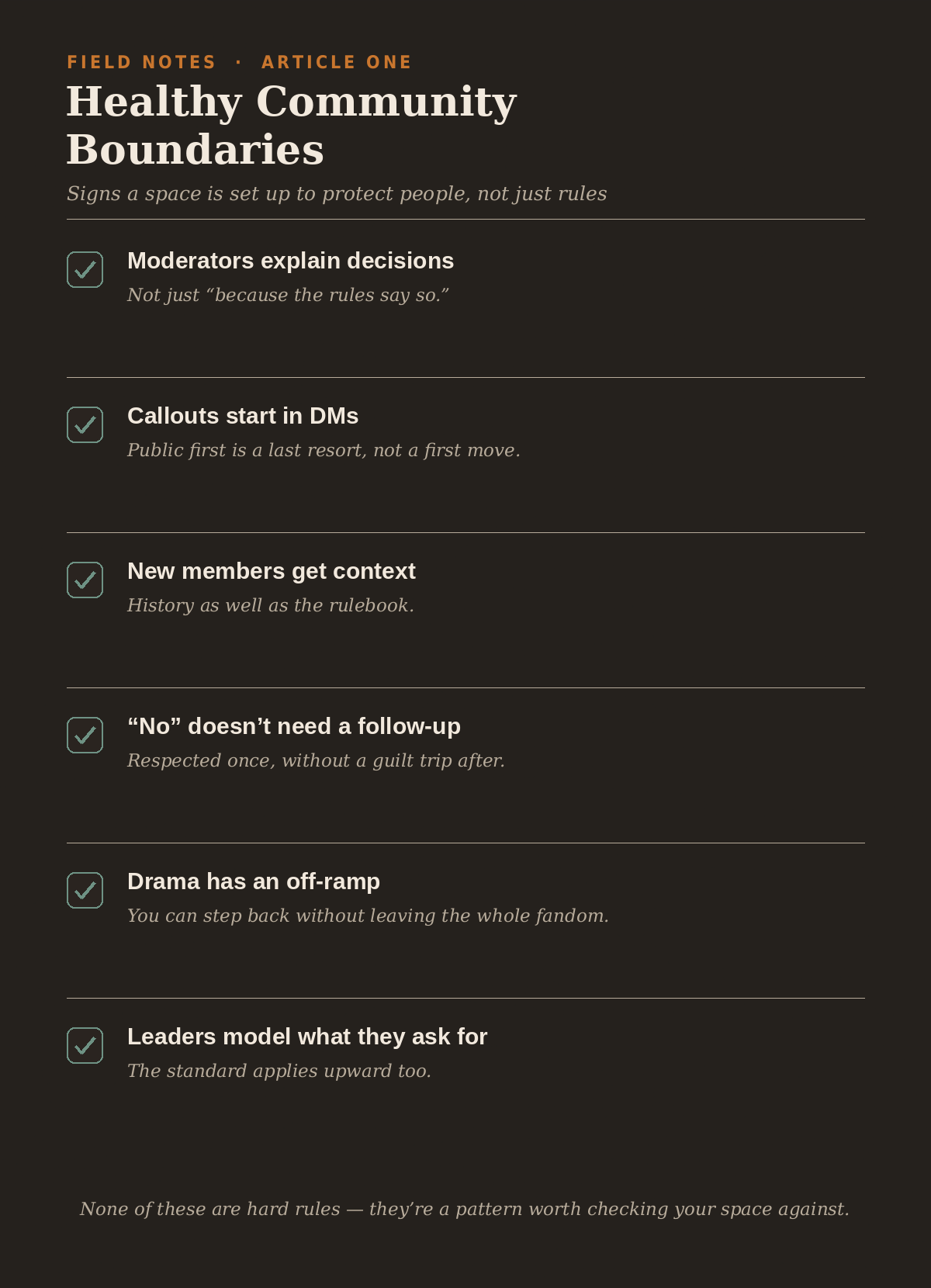
Before calling someone a close friend, ask:
- Do their actions remain kind when no audience is watching?
- Can they disagree without threatening the relationship?
- Do they protect private information?
- Can they celebrate another person’s success?
- Do they respect “no” without punishment?
- Do they tell the same story to different groups?
- Can they apologize specifically?
- Does their behavior change after an apology?
- Do they allow mutual friends independent relationships?
- Can they hold power without using it to settle personal conflict?
No friend will answer every question perfectly forever.
The pattern matters more than one bad day.
How to recognize repair instead of performance
- A friendship ending does not prove it was fake.
- Fake friendship becomes visible when closeness is repeatedly used for access, status, information, or control.
- Social exclusion can threaten belonging, self-esteem, control, and recognition.
- Protective separation is different from clique-driven division.
- Communities fracture through secrecy, triangulation, loyalty tests, coordinated exclusion, and inconsistent moderation.
- An apology can matter, but repair requires responsibility, restitution where possible, and changed behavior over time.
- Forgiveness, reconciliation, trust, and access are separate decisions.
- Nobody is owed renewed contact because they apologized.
- Leaders must separate personal relationships from moderation authority.
- A repaired community may look like peaceful coexistence rather than reunion.
FAQ about fake friendship and community division
Is blocking someone always community division?
No. Blocking can be a healthy boundary, especially after harassment, unwanted contact, or repeated conflict. Division becomes destructive when blocks are coordinated through pressure, used as loyalty tests, or expanded into punishment of uninvolved relationships.
Does someone deserve forgiveness after apologizing?
A person may deserve to have their apology heard. They are not entitled to forgiveness, reconciliation, restored trust, or renewed access. Those decisions belong to the harmed person and the relevant community process.
What if both sides caused harm?
Document each behavior separately. “Both sides” should not be used to erase power differences or specific actions. Each person can be accountable for what they did without creating a false mathematical equality.
Can a community remove someone without publicly explaining everything?
Yes. Privacy may limit public detail. The community should still have an internal evidence standard, documented reasoning, proportional action, and an appeal path where appropriate.
How do I know whether a warning about someone is credible?
Ask for behavior, dates, context, source proximity, and whether the concern was reported through an accountable channel. Avoid demanding sensitive victim information. Treat vague warnings as a reason for caution, not automatic proof.
Can trust return after repeated harm?
Sometimes, but trust should be rebuilt through sustained behavior rather than urgency. Repeated harm generally requires stronger boundaries, longer observation, and more concrete repair.
What should mutual friends do during a split?
Respect boundaries, refuse to carry messages, avoid sharing private information, and do not allow either side to dictate every independent relationship. Mutual friendship is not betrayal unless it is being used to bypass safety boundaries.
Where can Mello Zone members raise a concern?
Use the Safety Center, private reporting page, or appeal route. Community feedback can also be submitted through Community Voices.
Why this article exists
The Mello Zone contribution: Mello Zone applies lived community-moderation observation to research on ostracism, clique formation, apology, accountability, reconciliation, and trust repair in furry spaces where social fallout can fragment an entire group.
by Mello Zone Editorial Team.
Created a research-informed community psychology guide on fake friendship, ostracism, clique formation, community fragmentation, apology, accountability, forgiveness, reconciliation, and trust repair in furry spaces. Corrected the image alternative text to describe the displayed artwork; reporting and source-review dates are unchanged.
Read our sourcing, AI-assistance, and corrections policy.
Source links recorded for this article
- Ostracism, Annual Review of Psychology
- Apology and Restitution research
- Relational aggression in young adult friendships
- Dynamic Debates and online group polarization
- Online group membership and polarization experiment
- Ingroup bias in the furry fandom
- Helping in the furry fandom
- SAMHSA trauma-informed approaches