
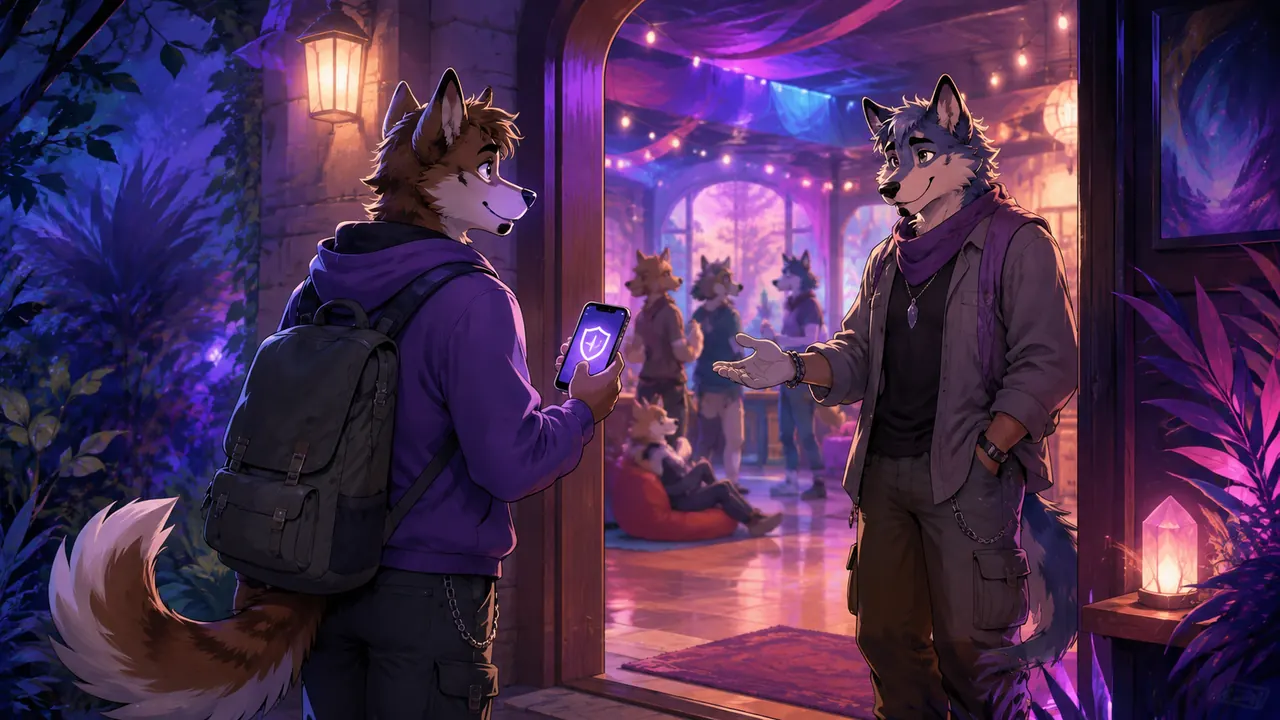
Editorial scope: This is an educational 18+ SFW article. It acknowledges adult subcultures without providing explicit instruction or treating visible identity as consent.
A good furry pup community should make joining feel clearer, not riskier. Before introducing yourself, confirm that the group is real, the adult and content rules are visible, moderators can be identified, privacy expectations are written, and members have a private way to ask for help.
Safety does not mean finding a magical server where conflict never happens. It means choosing a community that reduces predictable risks, gives you useful controls, responds to credible harm, and does not demand unnecessary personal information as the price of belonging.
Start with the official path
Use the community’s main website, verified social profile, or official platform group. Avoid invitation links forwarded through strangers, QR codes without context, shortened links from unsolicited messages, and “backup verification” pages hosted on unrelated domains.
The Mello Zone community hub connects the official website, Discord, VRChat, standards, events, and support paths. That structure matters because a newcomer can verify where a link came from before signing in or sharing information.
When a community has no stable public page, ask where its rules, staff list, privacy notice, and report form live. A small friend group may not need a corporate website, but it still needs honest answers.
Read the rules for examples, not slogans
“Be nice” is not a safety system. Useful rules explain the age threshold, SFW or NSFW boundary, harassment standard, direct-message expectations, recording policy, promotion limits, art-credit rules, event access, and consequences for severe conduct.
Look for examples of what is welcome, what is prohibited, and what requires asking first. The 18+ SFW guide explains why adult membership and adult content are separate boundaries. The community manifesto shows how Mello Zone applies consent, privacy, and creator respect to ordinary participation.
Decide what you will share before anyone asks
New communities can produce a rush of attention. Prepare a privacy line while your judgment is calm:
-
Use a community-facing name that does not expose your legal name by default.
-
Keep your exact address, workplace, school history, routine, and live location private.
-
Do not upload identity documents to a moderator’s direct message or an unexplained bot.
-
Remove metadata from photos when location or device information could create risk.
-
Use a unique password and two-factor authentication for important accounts.
-
Separate recovery email and public contact information when practical.
The FTC warns that personal information is valuable to scammers and account thieves. Friendly conversation can be genuine, but friendliness is not authentication.
Understand verification before completing it
An adult community may need a proportionate way to enforce its age rule. The process should answer the minimum necessary question without turning volunteer moderators into collectors of legal names, addresses, document images, or biometric data.
Before submitting anything, identify who operates the verification tool, what data is collected, how long it is retained, who can access it, and how deletion works. If the answer is “just trust us,” stop. A legitimate process can explain itself.
Platform age assurance and community membership review are not always the same thing. Do not assume a Discord, VRChat, or third-party badge reveals every detail to server staff.
Set direct-message boundaries early
Sharing a server does not create consent for private contact. You can restrict friend requests, close DMs from server members, ignore requests, or ask people to speak in public channels first.
A clear profile line can do quiet work: “Ask before DMs,” “SFW only,” “No flirting,” “Event contact only,” or “Slow replies are normal.” These phrases do not guarantee perfect behavior, but they make your boundary easier to enforce and document.
Discord’s blocking and privacy controls let users manage unwanted contact. Its reporting guide explains how to report messages that violate platform policy.
Watch how the community treats “no”
The fastest culture test is not the welcome message. It is the reaction to a boundary.
Healthy responses sound like: “No problem,” “Thanks for telling me,” or “We can use a different activity.” Red flags include guilt, public teasing, repeated requests, demands for a reason, threats to remove roles, or claims that a pack title overrides your choice.
Consent applies to avatar touch, nicknames, photos, barking games, gear, voice clips, role-play, emotional support, private groups, and real-world meetups. A yes to one activity is not a universal pass.
Learn the platform controls before the first event
On VRChat, practice opening the Quick Menu, selecting a user, muting voice, hiding an avatar, blocking, and finding the report flow. VRChat’s official blocking and reporting guide explains current controls, while the Safety and Trust System helps limit disruptive avatar features.
On Discord, know how to leave a server, close DMs, block an account, report a message, and preserve a message link. Do this before a stressful incident turns the interface into a maze.
Evaluate moderators by process, not personality
Charismatic staff can still run weak systems. Quiet staff can run excellent ones. Look for:
-
published rules that also apply to organizers and popular creators;
-
a private report route that does not require public accusations;
-
conflict-of-interest handling when a report involves a moderator’s friend;
-
proportionate action for severe conduct;
-
an appeal or correction path where appropriate;
-
privacy limits on who sees evidence;
-
clear separation between community action and platform reporting.
Mello Zone’s Safety Center describes the community process, while the private report path keeps sensitive concerns out of public channels.
Notice pressure tactics and social-engineering patterns
Scammers and manipulators often manufacture speed. They may claim that a role expires tonight, a verification failure will ban you, a friend needs emergency money, a creator account must be “tested,” or a moderator needs your login to restore access.
Slow the interaction down. Verify through a second official channel. Do not share passwords, backup codes, session tokens, payment-app codes, or remote-access control. The FTC’s guidance on romance scams is relevant because trust-building can happen through friendship, affection, or community belonging before a money request appears.
A real friend can tolerate verification. A scam needs momentum.
Protect creators and commissioners
Furry communities contain artists, avatar makers, fursuit makers, photographers, musicians, editors, and streamers. Use invoices or documented commission terms. Confirm which account is official. Be cautious when a new account claims to represent a familiar creator and asks for payment through an unusual method.
Do not send full-resolution character references, identity documents, or private photos merely because someone offers a free commission. Reverse-image search suspicious portfolios and ask for process evidence, not only polished examples.
Prepare for in-person events
Before attending a local pup social, furry meetup, convention gathering, or private party:
-
confirm the organizer, venue, age rule, content rating, start and end times;
-
arrange independent transportation and a way to leave;
-
tell a trusted person where you are going without posting the plan publicly;
-
keep your phone charged and payment method under your control;
-
understand photography, gear, changing-area, alcohol, and accessibility rules;
-
meet new contacts in the public event area before accepting a private invitation;
-
do not let a stranger hold your ID, phone, wallet, medication, or transportation access.
The event-host checklist shows what responsible organizers should define. Current Mello Zone formats appear on the community events page.
Red flags that deserve attention
-
Rules are hidden until after verification.
-
Staff ask for identity documents through personal DMs.
-
Members are punished for blocking a popular person.
-
Moderators pressure reporters to confront the accused privately.
-
Explicit content appears in a space advertised as SFW.
-
Leadership uses public humiliation as entertainment.
-
Pack, owner, or handler titles are treated as authority over nonparticipants.
-
New members are pushed to disclose trauma, finances, housing, or relationship problems.
-
The group discourages outside friendships or demands constant availability.
-
Complaints about scams, harassment, or doxxing are deleted without a private alternative.
One awkward message does not prove an entire community is harmful. Patterns, retaliation, secrecy, and boundary violations matter.
What to do when something goes wrong
-
Protect yourself first. Mute, block, leave, move to a trusted group, or contact an event host.
-
Preserve relevant context. Save dates, display names, message links, screenshots, and a short timeline. Avoid collecting unrelated private material.
-
Report to the correct platform. Discord and VRChat enforce their own rules.
-
Report to the community. A group may need to remove access even when platform review is separate.
-
Do not launch a public pile-on. Public accusation threads can expose victims, contaminate evidence, and amplify false information.
-
Step away. Repeatedly checking the other person’s profile can keep the incident emotionally active.
Leaving is a valid safety tool
You do not need a courtroom-level case to leave a group that feels wrong for you. A community can be legitimate and still be a poor fit. Remove connected apps, review shared servers, change reused passwords, revoke suspicious sessions, and ask trusted friends not to relay messages from blocked people.
Use the community platform guide to compare alternatives. Belonging is not a hostage negotiation.
Newcomer checklist
-
I used an official join path.
-
I read the age and content rules.
-
I understand verification and data handling.
-
My account has a unique password and two-factor authentication.
-
My public profile does not expose unnecessary personal information.
-
I know how to close DMs, block, leave, and report.
-
I know whether events are recorded.
-
I have independent transportation for in-person gatherings.
-
I know the private community report route.
-
I can participate slowly without pressure to prove myself.
Age verification without oversharing
Adult communities need a credible way to keep minors out, but a safety process can become risky when it collects more information than necessary. Before completing verification, pause and identify the exact question being answered. Usually the community needs to know whether you meet an age threshold, not your home address, document number, workplace, full legal history, or unredacted identity file.
Review the verifier’s privacy notice and use the official website or app rather than a link sent through a personal direct message. The FTC’s personal-information guidance explains why limiting exposed data matters when scammers and account thieves seek identifying details.
Red flags include moderators asking you to hold an ID beside your face in a private chat, requesting both sides of a document without explaining retention, saving verification images in ordinary server channels, or refusing to identify the service processing the check. Do not attempt to bypass a legitimate age rule. Choose a community with a process you understand and trust.
A fifteen-minute account safety setup
-
Change reused passwords. Use a unique password for the email account that controls recovery.
-
Enable two-factor authentication. Store backup codes somewhere safer than the device used to log in.
-
Review active sessions. Sign out devices or locations you do not recognize.
-
Limit unsolicited contact. Adjust server DMs, friend requests, mentions, and notification settings.
-
Separate public identity. Remove legal names, exact location, employer, and routine from the community profile.
-
Check connected apps. Revoke bots or integrations you no longer use.
-
Practice the exit controls. Know where block, report, leave, and privacy settings live.
This setup does not make an account invulnerable. It removes several easy doors before strangers begin knocking.
Cross-platform harassment needs a cross-platform plan
A conflict may begin in VRChat, continue through Discord, move to social media, and end with impersonation or unwanted contact on a payment platform. Treat each service as a separate evidence and safety surface.
Block where needed, report policy violations to each platform, and keep a short incident timeline with dates, usernames, message links, and the relationship between accounts. Do not repeatedly engage to gather dramatic screenshots. Preserve enough context for review, then reduce contact.
Tell trusted friends not to forward messages from the blocked person or add them to shared groups. Review mutual servers and public bios for details that reveal your routine. When an account impersonates you, direct followers to one official clarification rather than arguing under every fake post.
How to evaluate a first event
Your first event is a useful culture sample. Arrive with a simple plan: observe the welcome, identify the host, locate the exit or leave control, and notice how staff answer ordinary questions. You do not need to commit to the group because one evening was friendly.
Afterward, ask yourself:
-
Were the advertised age and content rules followed?
-
Could people opt out of photos, role-play, voice chat, or physical-style avatar interaction?
-
Did hosts respond calmly when someone needed help?
-
Were quiet, desktop, Quest, disabled, and new participants treated as full members?
-
Did anyone pressure me into a private channel, relationship, purchase, or disclosure?
-
Would I feel comfortable using the report route against a popular person?
A community earns trust through repeated ordinary behavior.
When a friend is the one raising the red flag
Safety advice is hardest to use when the concerning person is funny, generous, well-known, or emotionally close. Focus on the behavior rather than proving whether the person is entirely good or bad. Repeated boundary pushing, requests for credentials, financial pressure, identity threats, retaliation for blocking, and attempts to isolate you remain important even when mixed with affection.
Talk to someone outside the immediate group. A second perspective can reveal how much the community’s internal language has normalized. You may protect yourself before reaching a final judgment about the relationship.
Join slowly enough to observe the systems
Join slowly enough to see how the group behaves after the welcome confetti settles. Real community is visible in ordinary systems: clear rules, proportionate verification, respected boundaries, secure accounts, private reporting, creator protection, and the freedom to leave.
Why this article exists
The Mello Zone contribution: Mello Zone converts adult SFW pup-community and moderation experience into practical joining tests for boundaries, privacy, consent, platform controls, red flags, gradual trust, and leaving a space safely.
by Mello Zone Editorial Team.
Converted the sourced community safety guide draft into the native Mello Zone MDX format with current internal paths, image provenance, and an editorial review record. Replaced the hero with an article-specific, credited AI-generated conceptual illustration; reporting and source-review dates are unchanged.