
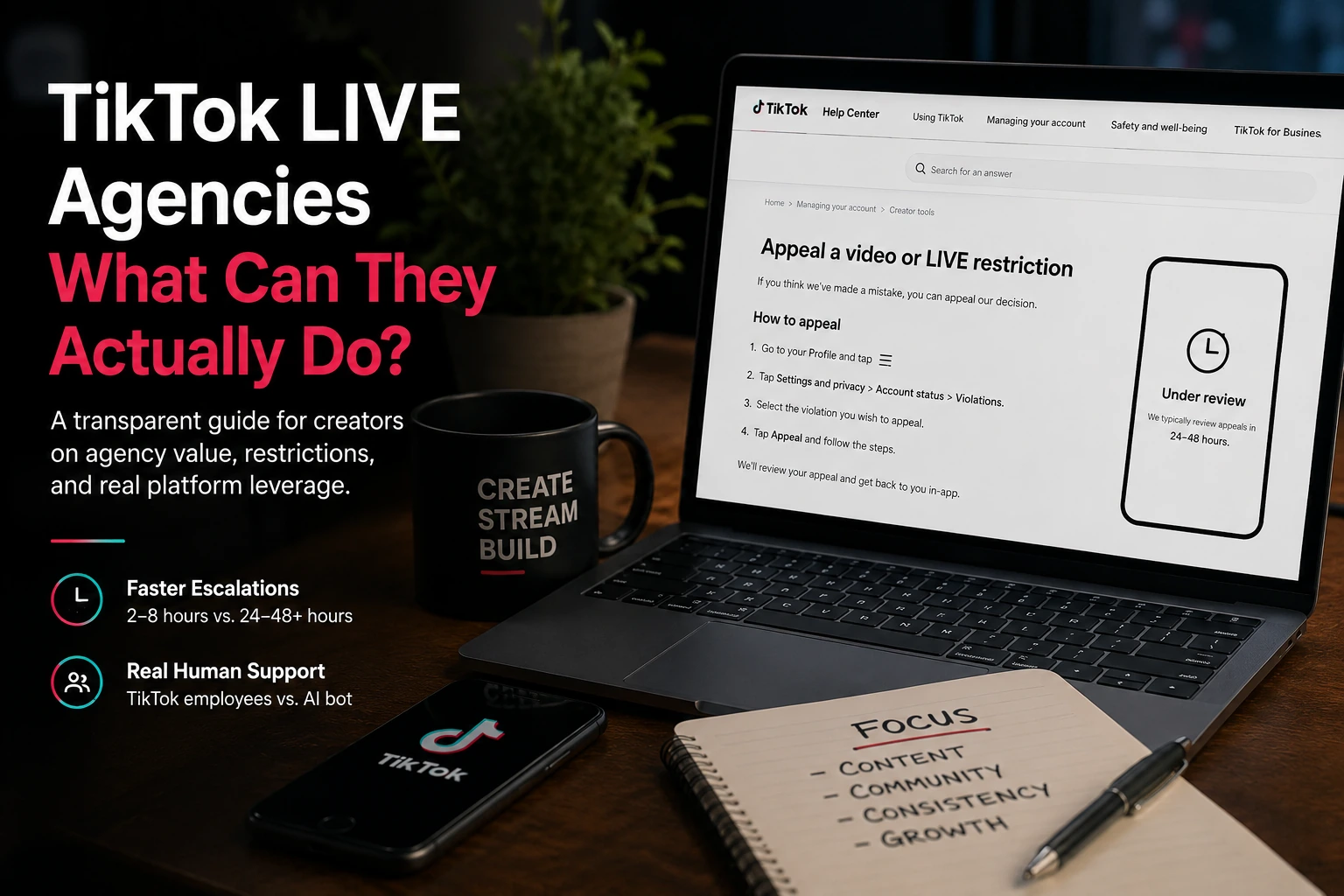
A TikTok LIVE agency can sound indispensable when its pitch includes growth strategy, analytics, promotion, coaching, networking, account protection, creator development, and access to TikTok tools. For a new creator, some of that guidance can be useful. For a creator who already understands content strategy, audience development, streaming, analytics, advertising, collaboration, and community building, the more important question is different: what can a TikTok LIVE Creator Network actually do that a capable independent creator cannot do alone?
After separating TikTok’s public creator tools from its Creator Network infrastructure, the answer becomes much narrower than many agency pitches suggest. Most growth work can be done independently. The two advantages that are hardest for a solo creator to reproduce are both connected to restrictions, violations, and platform support: a potentially faster escalation path when a LIVE or account restriction needs review, and access to network-side TikTok support relationships that can put a real person between the creator and an automated or self-service support flow.
Everything else should be evaluated separately rather than bundled together as “agency access.”
Editorial note: TikTok does not publish a universal public service-level agreement promising that independent appeals take a specific number of hours or that every Creator Network appeal will be resolved within a specific window. In the creator discussion that prompted this article, network-side turnaround was described as roughly 2 to 8 hours compared with roughly 24 to 48 hours, and sometimes several days, through ordinary creator support. Those figures should be treated as reported operational experience, not a guaranteed TikTok-wide SLA. TikTok’s public materials do support the broader distinction between normal creator appeals and Creator Network-side support infrastructure.
Mello Zone’s contribution in this analysis is operational rather than promotional: it compares Creator Network claims against the tools an experienced furry or VRChat creator can already access independently, then isolates the support and enforcement advantages that depend on the network’s platform relationship. For related community-side guidance on moderation and event operations, see the moderation and event-hosting topic.
TikTok Creator Networks are a real platform layer
TikTok calls these organizations LIVE Creator Networks and provides them with LIVE Backstage, a management platform designed specifically for organizations that manage groups of LIVE creators. TikTok’s public LIVE Backstage page says Creator Networks can connect with creators, use advanced tools, work with data-driven insights, receive support, and access incentives plus privileged features and tools.
The U.S. Creator Network onboarding criteria adds an important business detail: a network must operate through a registered corporate entity, meet TikTok’s eligibility criteria, and enter a Services Agreement with TikTok before receiving approved access to LIVE Backstage. This means a legitimate Creator Network is more than a Discord server with an agency logo. It has an actual relationship with TikTok.
But that fact alone does not mean every feature available to the network represents a capability the individual creator lacks. Some tools exist because the agency is managing many creators. A dashboard that lets a company compare hundreds of streamers is valuable to the company, but an individual creator does not necessarily need the same dashboard to understand one account. That difference is the heart of this analysis.
The first unique advantage: faster restriction and violation escalation
The clearest creator-facing advantage appears when something goes wrong. TikTok gives ordinary creators an appeal process. Its creator code of conduct and appeal documentation says creators who believe an account restriction was issued by mistake can appeal through the violation notification and can also contact TikTok in the app.
That means joining an agency is not required to appeal a restriction. The difference is the route the appeal can take. Ordinary creators generally enter TikTok’s standard consumer or creator support system, submit the appeal, provide whatever explanation or evidence is available, and wait for TikTok’s review process. A Creator Network can have additional support infrastructure through LIVE Backstage.
A publicly indexed copy of a 2026 Creator Network fee policy describes a “Priority Support” benefit for eligible networks. That document says qualifying networks can receive prioritized customer support, expedited appeal processing, and faster platform response and processing times through LIVE Backstage. It also describes expedited-appeal quotas, an important limitation because priority treatment may depend on the network meeting TikTok’s criteria and may not be unlimited.
Because that fee-policy copy is hosted by a third party rather than an openly indexed TikTok policy page, it should be treated as secondary evidence. However, it closely matches the broader support and privileged-feature structure TikTok publicly advertises for Creator Networks.
An agency does not give you the right to appeal. It may give your appeal a better lane.
When a creator’s income or audience depends on being able to go LIVE, the difference between “your ticket is in the normal queue” and “our network can escalate this through its platform relationship” can be genuinely valuable.
The second unique advantage: access to platform-side people
The other difficult-to-copy advantage is human access. TikTok’s public onboarding criteria says approved U.S. or Canadian Creator Networks are contacted by the TikTok LIVE team as part of the approval process. TikTok also operates the network relationship through LIVE Backstage and a formal Services Agreement.
That does not prove that every creator inside every network receives a personal TikTok employee on demand. It establishes something more modest and defensible: the network has an organizational relationship with TikTok that an ordinary standalone creator does not automatically have.
That relationship can matter when an issue cannot be solved by reading a Help Center article or resubmitting the same appeal. Independent creators can encounter automated responses, self-service troubleshooting, standardized forms, and support flows designed to serve TikTok at enormous scale. Those systems are necessary, but they can be frustrating when the problem is unusual or an automated enforcement decision appears wrong.
A strong Creator Network can serve as a translator and escalation point. Instead of the creator repeatedly explaining the issue to a generic support path, the network can package the case, identify the enforcement problem, supply relevant evidence, and use whatever network support channel TikTok currently makes available to it. TikTok still makes the enforcement decision, but access to a person who understands the platform-side process is fundamentally different from knowing how to fill out the same appeal form more eloquently.
Most TikTok growth tools are already available to creators
Once violations and escalation are separated from the discussion, the agency value proposition becomes much less mysterious. TikTok already gives creators direct access to a large amount of growth infrastructure.
Promote is one example. TikTok For Business says Promote can increase video views, followers, profile views, website visits, messages, and LIVE viewers. Creators can choose campaign goals, select or customize an audience, set a budget, choose a duration, and monitor results. TikTok’s documentation on where Promote can be opened also includes TikTok Studio, individual videos, Business Suite, before going LIVE, and while already LIVE.
In other words, “we can promote your LIVE” is not by itself an exclusive agency capability. A creator can do that.
The same applies to more advanced paid acquisition. TikTok Ads Manager is available as a separate advertising platform with targeting, reporting, campaign objectives, automation, and optimization tools. An agency may know how to use those tools well. That is expertise, not exclusivity.
Search research and content planning are not agency-only capabilities
Creator strategy is another area where language can make ordinary work sound gated. TikTok’s Creator Search Insights provides creators with information about what people are searching for, can surface popular topics and content gaps, and lets creators inspect how their own posts perform in search.
Creators can combine that with:
- TikTok Studio analytics
- retention and engagement observations
- stream timing experiments
- search behavior
- competitor research
- audience comments
- content-series testing
- website analytics
- cross-platform traffic
- paid campaign data
An experienced creator can turn those signals into a content plan without signing with a network. A good agency can still improve the process: a skilled manager may notice patterns the creator missed, compare results across multiple accounts, or bring experience from similar creators.
But the creator should ask a precise question: is the agency giving me information I cannot access, or is it interpreting information I already have? Both can have value. They are not the same service.
Normal appeals are available without an agency
TikTok explicitly documents an ordinary creator appeal path. When a creator receives a restriction and believes TikTok made a mistake, TikTok says the creator can open the relevant account notification, select the restriction, and submit an appeal. Creators can also contact TikTok through the app. TikTok’s LIVE troubleshooting documentation provides the ordinary support baseline.
This matters because agencies sometimes describe “appeal support” as though creators have no appeal rights without them. That would be misleading. The agency advantage is potentially speed, escalation, case handling, and access, not the mere existence of an appeal button.
A creator evaluating a network should therefore avoid asking, “Can you help with violations?” Almost every agency can answer yes to that. Ask instead: what support route do you have that I do not have as an independent creator? Then ask what happens after the network submits the case.
LIVE Backstage is powerful, but much of it manages the agency
LIVE Backstage is one of the strongest-sounding pieces of a Creator Network pitch because independent creators do not receive the same network dashboard. That is true, but it is also important to understand what the product is designed to do.
TikTok describes LIVE Backstage as a management platform for Creator Networks. Testimonials on TikTok’s own page emphasize comparing creator metrics, tracking network performance, monitoring large groups of creators, and measuring monthly objectives. Those are valuable capabilities when you operate an agency.
If you are one creator managing one account, the fact that your agency can compare you with 500 other creators is not automatically a benefit equal to having a tool you personally could never reproduce. The network may use that data to provide excellent coaching, or it may simply use the data to manage its own performance targets. Creators should evaluate the outcome, not the dashboard’s name.
Creator Networks also have their own incentives
There is another reason to understand the difference between creator value and network value: TikTok wants Creator Networks to perform, too. TikTok’s LIVE Backstage marketing emphasizes incentives for networks, including business growth, creator development, and network performance.
The publicly indexed 2026 fee-policy copy goes into considerably more detail. It describes metrics tied to creator activity, creator graduation, Diamonds, network benchmarks, and other performance measures. That does not make the model unethical. It means the network has economic incentives, and the creator should know what those incentives reward.
A well-aligned model can be excellent: the network earns more when creators become healthier, more active, more successful LIVE performers and therefore invests resources into helping those creators. A poorly aligned model can reward collecting accounts, pushing unnecessary LIVE hours, chasing gifting metrics, or prioritizing creators who are most profitable to the network.
That is why a creator should never treat “we do not take a cut of your Diamonds” as the end of the financial conversation. A better question is: what does TikTok reward you for when I perform well, and how does that affect what you will ask me to do?
Coaching, community, and networking can be valuable without being exclusive
This article is not arguing that everything an agency offers outside enforcement is worthless. A strong peer network can save time, a good manager can identify weak stream habits, an experienced creator can teach another creator faster than trial and error, and collaborations can introduce audiences to each other. A network can also organize events, battles, creator introductions, brand conversations, training calls, or feedback sessions.
Those are real services. They simply belong in a different category: things the creator could theoretically build or find independently, but may prefer to obtain through one organized network. That means their value depends on quality.
“Community” is not a feature by itself. A server with 500 creators who never collaborate is less useful than five peers who regularly review each other’s work. “Coaching” is not automatically valuable either. If the advice is “stream consistently, engage your chat, improve your lighting, use a schedule, and make better hooks,” an experienced creator may already know all of it.
For more Mello Zone coverage focused on creators, attribution, and online community, see the creator coverage topic.
The two-question test for an experienced creator
For someone who already knows how to make content, analyze performance, promote posts, research topics, build a community, and collaborate with other creators, the agency decision can be reduced to two questions.
1. Can you get a restriction or incorrect enforcement reviewed materially faster than I can?
Do not settle for “we help with bans.” Ask:
- What types of restrictions can you escalate?
- Is the escalation submitted inside LIVE Backstage?
- Is there a limit or quota on expedited appeals?
- Does your network currently qualify for priority support?
- What turnaround have your creators actually experienced?
- What evidence can you provide without exposing another creator’s private information?
- What happens when TikTok upholds the original decision?
A network operator may report two-to-eight-hour handling for some cases. That can be meaningful, but it should still be presented as historical performance rather than a guaranteed outcome.
2. When the normal support system fails, can you reach a real TikTok-side person?
Ask:
- Does the network have an assigned TikTok LIVE contact?
- Is that person a TikTok employee, contractor, partner manager, or another agency representative?
- Can the network actually communicate a creator-specific enforcement case to that contact?
- Which issues qualify?
- Is the contact available only to agency leadership?
- What is the escalation process after a first appeal is denied?
This is where a network can have something an independent creator cannot simply purchase through Promote or learn from ordinary creator education resources.
When joining a Creator Network makes sense
For an experienced creator, a network becomes compelling when the relationship has very little downside and provides demonstrable escalation leverage. Joining may make sense when:
- there is no creator-paid joining fee
- the network does not take the creator’s ordinary LIVE payout under the applicable agreement
- the creator can leave under reasonable terms
- there is no harmful exclusivity
- required LIVE hours fit the creator’s actual strategy
- the network has a documented support process
- the network can demonstrate successful restriction or violation escalations
- the network has active platform-side support access
- optional coaching or collaborations are genuinely useful
- the creator understands what data the network can see
- both sides understand how the network is financially incentivized
Under those conditions, the creator does not need to believe the agency possesses secret growth knowledge. The creator can join for a narrower reason: insurance against platform friction.
If everything works normally, the creator continues doing the work they already know how to do. If TikTok incorrectly restricts the LIVE account, the network becomes valuable because it can help move the problem through a different support channel.
When the agency adds little for an experienced creator
The equation changes when the promised benefits are mostly things the creator already has. If the pitch is primarily:
- analytics
- growth advice
- scheduling
- basic content strategy
- generic community
- ordinary collaborations
- Promote
- telling you when to go LIVE
- explaining your own retention
- teaching standard engagement techniques
then an experienced creator should ask whether joining actually changes anything. Convenience can still be worth something, but convenience should not be marketed as privileged access.
If the network cannot explain its escalation process, cannot explain what its TikTok relationship changes for the individual creator, and cannot distinguish network-only access from ordinary TikTok tools, the creator may be giving the network useful performance and revenue contribution while receiving very little they could not build themselves. That is the imbalance creators should watch for.
The real value proposition is leverage, not knowledge
The most useful way to think about a TikTok LIVE Creator Network is not: “They know how TikTok works and I do not.” For many experienced creators, that simply is not true.
A better model is:
The creator brings the content, audience, brand, community, experimentation, and execution.
TikTok provides the platform, distribution, monetization, advertising tools, creator tools, and ordinary enforcement system.
The Creator Network earns its place by providing leverage where the creator cannot easily reproduce it.
The most defensible examples of that leverage are faster escalation and organizational access to TikTok-side support. Everything else should have to prove its own value. That is a healthier standard for both creators and agencies because it does not diminish good Creator Networks; it gives them a clearer job.
If an agency truly has an effective relationship with TikTok, can resolve erroneous enforcement faster, knows how to build a strong case, and puts a real human advocate between the creator and a frustrating platform problem, that can be worth joining for even when the creator needs no help producing content. But if the supposed exclusive benefits turn out to be buttons already sitting inside TikTok Studio, the mystique evaporates quickly.
The best question a creator can ask an agency is therefore still the simplest:
What can you do for my account through your Creator Network status that I cannot access, buy, learn, or accomplish independently?
The answer should be concrete.
Why this article exists
The Mello Zone contribution: Mello Zone evaluates TikTok LIVE Creator Networks from the standpoint of a furry and VRChat creator community that operates livestreams and creator infrastructure, separating ordinary self-service growth tools from the network-only escalation leverage that matters when enforcement or support fails.
by Mello Zone Editorial Team.
Created a source-reviewed creator guide separating growth tools that independent TikTok creators can already use from the enforcement escalation and platform-side support that can make a Creator Network materially different. Corrected the image alternative text to describe the displayed artwork; reporting and source-review dates are unchanged.
Read our sourcing, AI-assistance, and corrections policy.
Source links recorded for this article
- TikTok LIVE Backstage - Creator Network solutions
- TikTok LIVE Creator Network Onboarding and Operation Criteria - US region
- TikTok Support - Creator code of conduct and appeals
- TikTok Support - Issues with TikTok LIVE
- TikTok For Business - Promote 101
- TikTok For Business - How to find Promote in-app and on web
- TikTok Support - Creator Search Insights
- TikTok For Business - TikTok Ads Manager 101
- TikTok Newsroom - Supporting creators with an updated account enforcement system
- Publicly indexed third-party copy - 2026 Creator Network Fee Policy priority support section
- TikTok For Business video - How to drive action with TikTok Promote
- Independent tutorial - How to appeal a TikTok Community Guidelines violation