
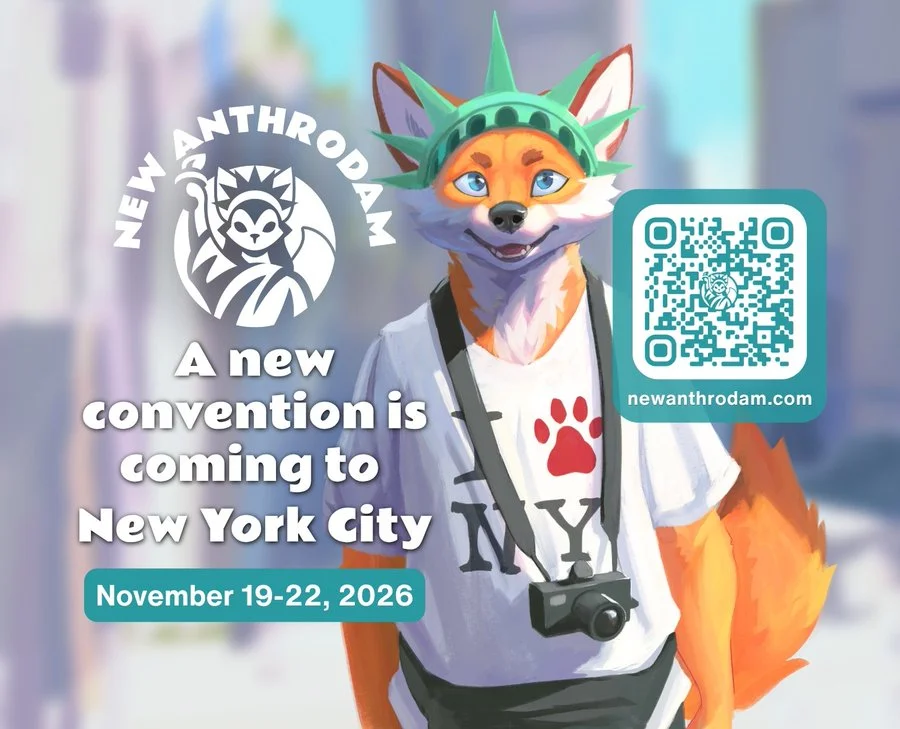
New Anthrodam 2026 is scheduled for November 19–22 at the New York Marriott at the Brooklyn Bridge. The organizers describe it as New York City’s first full furry convention, and the official site currently publishes dates, venue, registration, hotel, conduct, volunteering, and panel information.
That makes the event credible enough to research and plan around. It does not make every detail final.
The first signal for this article came from a short item on Furry Refuge News. Mello Zone did not reuse that post’s wording, image, or structure. We treated it as a discovery lead, then checked the planning details against the event’s own pages, the hotel, and the local-community sources listed above.
What would make a first-year furry convention in one of the world’s most expensive and transit-rich cities genuinely useful, accessible, and trustworthy?
Editorial scope: this is an independent planning analysis based on public information checked August 21, 2026. Mello Zone is not affiliated with New Anthrodam, has not inspected the event in person, and does not claim firsthand knowledge of staff readiness or attendee experience. Details may change, so confirm them with the official sources before purchasing or traveling.
The announcement is real, but the better story is the operating test
A basic announcement can fit into a few lines: name, date, hotel, registration link. That is useful for discovery, but it leaves most of the attendee’s real decision unanswered.
New Anthrodam is more interesting as an operating test.
New York already has furry meetups, art events, walks, nightlife, virtual gatherings, and regional networks. The question is not whether enough furry people live nearby. The question is whether a first-year hotel convention can translate that existing scene into a safe, affordable, accessible, and accountable multiday event.
That distinction matters because “first” is a powerful marketing word. It can make a new event sound historically inevitable before the doors have opened. New Anthrodam’s organizers are entitled to describe their project, but attendees should separate a stated first from a proven operation.
Mello Zone’s wider furry convention growth analysis makes the same point at a larger scale: growth is not only attendance. It is the ability to repeat that growth responsibly, publish credible operating information, and continue serving people after the novelty fades.
Verified New Anthrodam 2026 facts
The event’s official website currently supports these core facts:
| Planning item | Public information checked August 21, 2026 |
|---|---|
| Dates | November 19–22, 2026 |
| Venue | New York Marriott at the Brooklyn Bridge, 333 Adams Street, Brooklyn |
| General event rating | All ages, with explicitly designated adult-only programming and areas |
| Standard preregistration | $85 through November 4 |
| Standard at-door registration | $99 beginning November 5 |
| Day passes | $50 Friday, $50 Saturday, and $40 Sunday |
| Official room-block estimate | $415.45 per night after listed taxes and occupancy tax |
| Parking | $60 per day |
| Adult badge pickup | Government-issued photo ID required for attendees over 18 |
| Refund policy | Generally non-refundable, with transfer or rollover options described by registration staff |
| Organizer | New York Anthropomorphic Appreciation Association |
The official registration page also lists Sponsor, Super Sponsor, Benefactor, and hotel-inclusive packages. Benefits, availability, and conditions vary by tier, so attendees should compare the live descriptions before purchasing.
The official first-year hotel promotion is unusual enough to read carefully. A room booked for at least two nights inside the convention block can qualify for two Standard-to-Sponsor upgrades after the reservation is verified under the published promotion terms. Travelers should confirm those terms before treating the upgrades as part of their budget.
The policy details are a positive sign because they reduce guesswork. They also create a duty to keep the page current. A price table that was accurate in August can become misleading in November if deadlines, sold-out tiers, room availability, or terms change without a visible update.
New York already has a furry scene
New Anthrodam’s organizers describe the project as carrying forward momentum created by independent local gatherings. That framing is more accurate than presenting the convention as the moment furry life began in New York.
New York Furs says it began in 2021 as a small project for in-person events and developed into a statewide event network. Its public calendar documents recurring activity rather than a one-time convention program.
NYC FurMeets documents another local organizing stream, including recurring FurWalks and connections with neighboring organizers. Anthros NYC presents a separate anthropomorphic art exhibition. Together, these sources show distinct forms of local organizing rather than one unified organization.
Those projects matter to New Anthrodam for three reasons.
First, they show that local demand does not need to be invented. Second, they represent accumulated knowledge about venues, transit, accessibility, safety, and New York-specific community expectations. Third, they are potential collaborators whose history deserves clear credit.
A convention can become a bright annual landmark without swallowing the smaller events that gave the local scene its roots. The healthiest relationship would be an ecosystem:
- Local groups keep year-round community alive.
- Art events give creators focused space.
- Virtual groups support people who cannot travel.
- Regional meetups help newcomers build confidence.
- The convention creates a larger annual gathering.
- Every organizer credits the others instead of treating community history as blank real estate.
That is a stronger origin story than a single event declaring itself the beginning.
The hotel price changes the accessibility conversation
The official room block is listed at $359 before taxes and occupancy charges, with an estimated total of $415.45 per night. The block waives the hotel’s usual destination fee, and the convention page explains the listed taxes, room occupancy, parking rate, and cancellation timing.
Even with that waiver, the hotel is expensive.
Four nights at the current estimated total equal about $1,661.80 for one room. Split among four adults in a two-double room, that is about $415.45 per person for lodging. Adding one $85 Standard badge puts the illustrated lodging-and-registration subtotal near $500.45 per person, before travel, food, charges outside the stated estimate, or personal spending.
A shorter two-night stay split among four adults would put room and Standard badge costs around $292.73 per person under the same assumptions. That is an illustration, not a quote or promise. Room availability, taxes, tier availability, and roommate arrangements can change the actual amount.
The hotel page gives attendees useful cost details that convention sites sometimes bury:
- Maximum room occupancy
- Listed taxes
- Cancellation timing
- Destination-fee waiver
- Wi-Fi conditions
- Rollaway restrictions
- Parking price
- Nearby food
- Subway access
That specificity is valuable. The next improvement would be a compact attendee budget tool showing common scenarios such as commuter, day-pass visitor, two-night shared room, and four-night shared room. The tool should label its assumptions and link back to live rates.
Cost accessibility is not solved by telling people to split a room. Not everyone can safely share sleeping space, and some disabled attendees need a specific room type, a quieter arrangement, a caregiver, or guaranteed accessible features. Commuter and day-pass options therefore matter alongside shared-room examples.
Transit is the convention’s biggest urban advantage
A Brooklyn hotel at this price would be a much harder sell if attendees also needed a car.
The official hotel guide lists the A, C, and F trains at Jay Street–MetroTech, a connection to the R at Court Street, and the 2, 3, 4, and 5 trains at Borough Hall. The page presents the location as reachable without relying solely on a car.
That creates several practical advantages:
- Local attendees can commute instead of booking a room.
- Day-pass holders can avoid parking.
- Visitors can reach food and supplies without a car.
- Attendees can extend the trip into a broader New York visit.
- Roommates can arrive through different airports or rail terminals.
- A cancelled ride does not necessarily isolate someone at a suburban hotel.
Parking is listed at $60 per day, which makes the transit advantage even more important.
Transit access should still be described carefully. A nearby station is not automatically a complete accessible route for every person. Elevators can be at a different entrance, outages occur, crowding affects wheelchairs, luggage, and fursuit bins, and service changes can disrupt a planned route.
A professional travel page would add:
- Official MTA trip-planning link
- Current elevator-status link
- Step-free route guidance
- Airport and intercity rail examples
- Rideshare pickup point
- Paratransit or accessible taxi information
- Late-night travel notes
- A weather and luggage plan
- A clear warning that attendees should check service changes close to travel
New Anthrodam does not need to become a transit authority. It does need to translate its location advantage into usable attendee instructions.
Venue accessibility is not the same as event accessibility
Marriott’s official property information documents a meaningful set of building and room features. The hotel lists elevators, an accessible main entrance, accessible meeting spaces and restaurants, accessible guest rooms, and other features on the property page. Those are hotel-level representations, not a convention service plan.
Marriott also advises guests to select a specific accessible room type during booking when a feature must be guaranteed. Adding an accessibility preference to a standard room may be treated only as a request rather than a guarantee, so the bookable room description and confirmation matter.
That covers the venue. It does not answer every convention question.
At the time this draft was reviewed, the available public sources did not give us enough detail to verify a complete convention-specific accommodation menu. We therefore are not claiming that New Anthrodam will provide any specific service until its organizers publish it.
Useful event-level information could include:
- An accessibility contact who answers before the event
- An accessible registration lane
- Assistance for people who cannot stand in long lines
- Reserved seating at selected events
- Quiet or low-sensory space
- Large-print or screen-reader-friendly schedules
- Communication cards or other aids
- Clear service-animal expectations
- Mobility-device storage or charging information
- Companion or caregiver procedures
- Accessible route markings on the hotel map
- A process for requesting accommodations without disclosing more medical information than necessary
Anthro SoCal’s public accessibility page offers one useful benchmark. It publishes concrete procedures for requesting and using event-level assistance. New Anthrodam can use that level of operational detail as a comparison point without copying another event’s program.
Mello Zone’s event safety guide treats accessibility as part of event operations rather than a decorative promise. That standard should apply to every growing convention.
All-ages programming needs visible boundaries
New Anthrodam’s Code of Conduct defines the convention as all ages with specific adult-only events, areas, or exhibits. The panel application separately says 18+ programming is generally grouped into a designated Friday-night period. Attendees should check the current schedule and policies because application guidance is not a final program.
This is a workable model.
An all-ages convention does not require every panel to be designed for children. It does require public spaces, schedules, signage, and access controls that make the boundary understandable.
The official rules already cover several useful foundations:
- Consent is required for physical contact.
- Fursuits and costumes are not consent.
- Harassment and discriminatory conduct are prohibited.
- Minors are excluded from mature areas.
- Badges must be worn in convention space.
- Weapons are prohibited.
- Alcohol is limited to appropriate licensed areas.
- Public attire and conduct are expected to fit a shared hotel environment.
The next test is execution.
A newcomer should not need insider vocabulary to understand whether an event is all ages, 16+, 18+, educational but mature, or explicitly adult. A parent should not discover the rating at the room door after arriving.
The schedule should use consistent ratings, plain-language descriptions, age-check locations, and an explanation of why mature events are grouped where they are.
Mello Zone’s analysis of adult programming at all-ages furry conventions reaches the same conclusion: honest separation is safer than denial or euphemism.
The false-report rule needs a good-faith safeguard
The current Code of Conduct says false reports or accusations are treated as harassment and notes that falsely reporting a crime can involve law enforcement.
Knowingly fabricating an accusation can cause real harm. A convention is justified in reserving consequences for deliberate deception.
The policy would be stronger if it explicitly separated deliberate fabrication from a good-faith report that cannot be substantiated.
Those are not the same thing.
A person may report an incident honestly while:
- remembering the time imperfectly
- lacking a witness
- misunderstanding a name
- having incomplete screenshots
- describing conduct that violates community rules but is not a crime
- becoming overwhelmed during an interview
- withdrawing from the process
- presenting evidence that staff cannot independently confirm
A safety policy should never imply that an unproven report is automatically a false report.
A clearer standard could say that retaliation, malicious fabrication, or knowingly altered evidence may lead to action, while reports made honestly and in good faith will not be punished merely because an allegation could not be substantiated.
That protects both sides of the process. It gives staff room to address deliberate abuse without placing a thundercloud over everyone considering a report.
The convention should also publish:
- Where reports are made
- Who receives them
- Whether anonymous reports are accepted
- What evidence is useful
- How confidentiality is handled
- What outcomes are possible
- Whether an appeal or review exists
- When venue security or emergency services should be contacted
- A non-retaliation promise
Mello Zone’s furry community event-host checklist and Safety Center provide broader frameworks for separating intake, evidence, immediate safety response, escalation, documentation, and follow-up.
A first-year convention needs operational transparency
New Anthrodam’s volunteer page openly recruits across Marketing, Creative, Events, Operations, Business, Attendee Relations, Human Resources, IT, and Safety. That list shows an understanding that a convention requires more than programming.
It does not prove that every department is fully staffed, and the article should not pretend otherwise.
First-year events face a particular trust problem. They lack a previous closing ceremony, attendance history, post-event report, charity total, incident summary, or attendee pattern. The best substitute is specific, dated public communication about what is confirmed, under review, or pending.
A public status page could show:
| Area | Useful public status |
|---|---|
| Registration | Open, deadline, tiers sold out, transfer rules |
| Hotel | Block open, nights unavailable, cancellation deadline |
| Programming | Applications open, review underway, schedule date |
| Dealers | Applications open or closed, acceptance timeline |
| Accessibility | Contact active, services confirmed, request deadline |
| Volunteers | Departments recruiting, general onboarding status |
| Safety | Conduct policy date, report location, emergency boundaries |
| Travel | Transit links, service-change reminder, weather update |
| Communications | Last updated, next planned update, correction log |
This is not an invitation to publish private staffing numbers or security plans. It is a way to distinguish “under construction” from “nobody knows.”
The official site already contains unusually detailed registration and hotel pages. Extending that discipline to schedule status, accessibility, and reporting would give the first year a firmer foundation.
What attendees should verify before spending money
A furry-news post can tell you that New Anthrodam exists. A useful planning guide should help you avoid assumptions.
Before purchasing, verify:
Registration
- Your selected tier is still available.
- The preregistration deadline has not passed.
- Your legal registration name matches the ID you will bring.
- You understand the non-refund policy.
- You know how transfer or rollover requests work.
- A day pass would not fit your plans better.
Hotel
- You are inside the official room block.
- The final checkout total matches the advertised fee waiver.
- Your roommate count fits the room.
- The bed configuration works for the group.
- Any accessible room feature is guaranteed, not merely requested.
- Everyone understands cancellation and incidental-hold rules.
Travel
- Your route still runs on the travel date.
- You know which station entrance you need.
- You have a backup route.
- You have accounted for luggage, fursuit bins, mobility equipment, and weather.
- You know where to meet your roommates.
Event access
- You have the required ID or minor-consent documents.
- You understand the general PG environment.
- You know how 18+ programming is identified.
- You have read the current Code of Conduct.
- You know where Con Ops and the attendee help desk will be.
- You have an emergency contact outside the event.
Personal safety and capacity
- You have medication, chargers, water, and cooling needs covered.
- You have a plan for sensory overload or social fatigue.
- You know how you will leave an uncomfortable situation.
- You are not relying on a stranger for lodging or transportation without safeguards.
- You have not shared private identity evidence through an unofficial channel.
The Mello Zone attendee safety guide expands this into a broader preparation and reporting plan.
What New Anthrodam could add to the wider furry map
A successful New York furry convention could matter beyond one weekend.
The city is internationally connected, visually recognizable, culturally dense, and already home to an active local furry scene. A Brooklyn convention could create unusual opportunities:
- A stronger bridge between furry art and the wider creative economy
- Public transit access for attendees who do not drive
- Easier attendance for Northeast rail travelers
- International participation through several major airports
- Collaboration with existing regional groups
- Creator events that use New York’s gallery and performance culture
- More visible furry participation in a major global city
- A convention model that does not depend on a remote resort or suburban car access
Those possibilities are not guarantees.
New York’s strengths also create pressure: high lodging costs, crowded transit, complex venue boundaries, intense public visibility, and competition for volunteer time. The convention will need to turn those pressures into concrete travel, access, safety, and staffing plans.
The best outcome would not be New Anthrodam replacing New York’s local events. It would be the convention becoming one annual layer in a larger scene that continues through NYFurs, NYC FurMeets, and Anthros NYC before and after the convention weekend.
Mello Zone’s take
New Anthrodam has a more substantial public foundation than a one-page announcement.
The official site gives attendees dates, venue, tier pricing, hotel costs, transit routes, ID rules, minor policies, conduct expectations, volunteer departments, and a framework for 18+ panels. That is enough to support informed planning, but it is not evidence of completed operations.
The exceptional first-year test is what comes next:
- Keep financial and schedule information visibly current.
- Publish detailed event-level accessibility services.
- Add a good-faith reporting safeguard.
- Make all-ages and 18+ boundaries unmistakable.
- Show operational progress without exposing sensitive plans.
- Respect and collaborate with the local groups that built New York’s furry scene.
- Publish corrections and a post-event report after the doors close.
That is a higher standard than repeating an announcement. It is also a fairer one.
A first-year convention should not be expected to operate with the history of a twenty-year institution. It should be expected to explain what it knows, label what is still moving, protect attendees, and document outcomes honestly.
For current dates, prices, room availability, applications, and policies, use the official New Anthrodam website. For broader convention planning and community context, use the Mello Zone guides linked above.
Why this article exists
The Mello Zone contribution: Mello Zone evaluates New Anthrodam as community infrastructure, combining its first-year policies with New York furry context, hotel access, transit, volunteering, program design, affordability, and attendee safety.
by Mello Zone Editorial Team.
Prepared an original Brooklyn-focused convention analysis using Furry Refuge as a discovery source and official event, hotel, community, and accessibility sources for factual verification. Corrected the image alternative text to describe the displayed artwork; reporting and source-review dates are unchanged.
Read our sourcing, AI-assistance, and corrections policy.
Source links recorded for this article
- New Anthrodam official website
- New Anthrodam registration and attendance policies
- New Anthrodam hotel, room block, and transit information
- New Anthrodam organization and local-scene statement
- New Anthrodam Code of Conduct
- New Anthrodam volunteer departments
- New Anthrodam panel application and 18+ programming policy
- New York Marriott at the Brooklyn Bridge accessibility features
- Marriott guidance for reserving accessible rooms
- New York Furs organization history
- New York Furs public event calendar
- NYC FurMeets local event network
- Anthros NYC anthropomorphic art exhibition
- Anthro SoCal public accessibility service model
- Furry Refuge News discovery feed