September 7 status review: the September 5 San Japan parade and IndyFurCon Menagerie dates discussed below have passed. San Antonio Furs still publishes the planned noon route, and IndyFurCon retains its Menagerie explanation. Furry Migration’s July notice, Anthro New Mexico’s FAQ and Anthrocon’s July cancellation update still support the contrasting route decisions. These are organizer announcements, not independent confirmation that either September 5 event ran as planned. References to tomorrow below belong to the September 4 report.
Tomorrow at noon in San Antonio, a furry parade is supposed to move through the middle of a million-square-foot anime and gaming convention complex.
At almost the same time in Indianapolis, another furry convention is doing the opposite.
No parade.
Instead, IndyFurCon is gathering fursuiters into a stationary Menagerie for photos, poses, and crowd interaction.
One tradition. Two completely different answers.
That is the furry-news signal hiding in this Labor Day weekend.
The fursuit parade is not simply disappearing, and it is not simply getting bigger. It is being re-engineered around venue geometry, heat, crowd flow, accessibility, city coordination, and the question every organizer eventually has to answer: can hundreds of costumed people actually move through this space safely?
The strongest current evidence comes from official event and community pages, not attendee rumor.
San Antonio Furs says River City Furry Events is returning to San Japan for its third year and will host its second furry parade on Saturday, September 5, this time through the convention center, beginning at noon. IndyFurCon’s current schedule says its Fursuit Photo and Menagerie runs Saturday from 11:30 a.m. to 1:00 p.m. and explicitly says the convention is trying the Menagerie instead of a parade this year.
Meanwhile, Furry Migration has already canceled its 2026 parade because the Hyatt Regency Minneapolis layout created route, occupancy, fire-safety, and city-planning problems. Anthro New Mexico says its hotel does not provide a safe or direct parade route. Anthrocon canceled its July parade and block party because of heat and extreme weather.
These are not five copies of the same story.
They are five pieces of one structural change.
⚡ The Short Pour: What Is Verified Right Now
Here is the clean evidence line.
San Antonio Furs’ current September calendar says San Japan 17 is running September 4-6 at the Henry B. González Convention Center. It lists a San Japan Group Photo, Parade and Panel for September 5 and says River City Furry Events is returning for its third year at the convention.
The same page says this will be the community’s second furry parade at San Japan and adds the important operational change: “this time” the parade will go through the convention center, starting at noon.
San Japan’s official site independently confirms the September 4-6 dates and the Henry B. González Convention Center location. Its hotel and venue information says the event uses the convention center plus neighboring hotel programming across more than 1,000,000 square feet of combined space.
In Indianapolis, the current IndyFurCon Fursuit Photo and Menagerie event page schedules the event for September 5 from 11:30 a.m. to 1:00 p.m. and says the convention is trying something new with the Menagerie instead of a Parade this year.
The IndyFurCon FAQ describes the Menagerie as a gathering of fursuits in one space for group photos, poses, and general fursuit activity. The FAQ places it in the first-floor lobby area.
Those are verified published plans.
What is not verified yet is tomorrow’s real-world execution. Mello Zone has not independently observed the San Japan parade route, measured crowd density, verified the exact number of fursuiters who will participate, or watched IndyFurCon’s Menagerie operate. A live schedule is evidence of intent and current event design, not proof that every part will happen exactly as published.
That distinction matters because fandom reporting gets sloppy fast when a schedule screenshot turns into a claim about what already happened.
🐾 San Antonio Is Expanding the Parade Instead of Retreating From It
The San Antonio case is especially interesting because the parade is not being staged by a furry convention.
It is being built inside a much larger anime and gaming convention.
River City Furry Events and the wider San Antonio furry community are effectively creating a furry-programming layer inside San Japan: a group photo, parade, panel, community table, and a bridge to the nearby Alamo City Furry Invasion.
That changes the purpose of a parade.
Inside a furry convention, the parade is often an internal celebration that spills toward the public.
Inside San Japan, the parade is also a visibility mechanism. It puts a local furry community in front of anime fans, cosplayers, gamers, artists, parents, vendors, photographers, and attendees who may never have walked into a furry-specific event.
It is recruitment, culture-sharing, performance, and community identity compressed into a moving line of ears, tails, paws, foam, fur, and somebody inevitably trying to keep a giant dragon tail from clotheslining a Pikachu.
The phrase “through the convention center” is the key detail.
It suggests River City Furry Events is moving the parade into a controlled indoor environment rather than treating an outdoor public route as the default expression of success.
That does not automatically make it safe. Indoor routes can still bottleneck. Escalators, narrow hallways, vendor traffic, accessibility paths, heat buildup, spectators stopping for photos, and ordinary convention congestion can turn a simple walk into a fuzzy traffic jam.
But San Japan has something many hotel conventions do not: enormous purpose-built convention-center circulation space.
That gives organizers a different set of options.
🌀 IndyFurCon Is Asking a Different Question
IndyFurCon’s Menagerie starts from the opposite premise.
Instead of asking, “How do we move the fursuiters through the building?” it asks, “What if the people come to the fursuiters?”
That is a meaningful redesign.
A parade creates a route.
A Menagerie creates a zone.
Routes require continuous movement, line control, staging, handlers, crossings, route marshals, spectator management, evacuation options, and enough space for the front of the parade not to collide with the back of it.
A stationary gathering still needs crowd management, cooling, accessibility, staffing, and exit paths, but it removes one giant variable: hundreds of people no longer need to travel together as one organism.
That can make photography easier too. IndyFurCon explicitly frames the Menagerie around group photos, poses, and the spectacle of seeing many fursuiters together.
The tradition’s emotional center survives.
The locomotion does not.
For a fandom that sometimes treats the parade itself as sacred, that may sound like a downgrade.
It is better understood as a format change.
Mello Zone’s separate IndyFurCon accessibility report already found that the convention is adding a Quiet Room, Dignity Support Services, fursuit cooling, and sensory-safe dance programming this weekend. The Menagerie fits the same broader operational pattern: convention design is becoming less about one spectacular default and more about building multiple ways for people to participate without forcing everyone through the same physical experience.
🚧 Furry Migration Shows Why Venue Geometry Eventually Wins
Furry Migration provides the clearest first-party explanation for why a parade can fail before anyone puts on a fursuit head.
In its July 30 parade update, Conchair Rico says the convention decided not to schedule a 2026 parade after reviewing possible routes at the Hyatt Regency Minneapolis.
The reasons are unusually specific.
Potential routes became too complicated to operate, interfered with other convention activity, required extensive planning with the city, or began approaching occupancy and fire-safety concerns the convention was not willing to compromise on.
That is the unglamorous reality of scale.
A parade is not just a line of fursuits.
It is an occupancy event.
It changes where hundreds or thousands of bodies are concentrated. It can temporarily consume hallways that normally function as circulation. It can block ordinary attendees from reaching programming. It can create crossings between spectators and participants. It can turn elevators into pressure points. It can create emergency-egress questions that do not exist when the same people are distributed across the hotel.
Furry Migration also says it explored alternatives and wanted another memorable way for suiters to gather rather than forcing a route that did not meet its standard.
That is the same conceptual move IndyFurCon is making, even if the exact replacement is different.
The parade’s function is being separated from the parade’s format.
🏨 Anthro New Mexico Hit the Same Wall in Its First Year
This is not only a problem for large established conventions.
Anthro New Mexico’s current About and FAQ page says its inaugural convention will not have a fursuit parade because the hotel layout does not provide a safe or direct route.
That convention is brand new.
It has not had years of parade growth to overwhelm a route.
The constraint exists from day one.
That makes the New Mexico example useful because it destroys a common assumption: that parade problems are only a symptom of enormous attendance.
Sometimes the building simply says no.
Mello Zone’s opening-day Anthro New Mexico report examined how a local Albuquerque furmeet network grew into a convention. The parade decision shows the other side of that growth. Community energy can create an event, but energy cannot move a wall, widen a hallway, or invent a safe loop through a hotel that does not have one.
☀️ Anthrocon Added Weather to the Equation
Then there is Pittsburgh.
Anthrocon had a route, public visibility, city coordination, a block party, and a massive convention center.
Weather still won.
Anthrocon’s official Parade and Block Party page records its July 3 decision to cancel the 2026 Fursuit Parade and Block Party because of the heat and extreme weather forecast for July 4.
That cancellation is already the subject of Mello Zone’s full heat-plan analysis, so there is no reason to retell that story here.
The important connection is simpler.
Parade viability now depends on three geometries at once:
- the geometry of the building,
- the geometry of the crowd,
- the geometry of the environment around them.
A route that works on paper can become irresponsible when heat, severe weather, construction, street closures, or emergency resources change.
That is why “we have always had a parade” is not an operating plan.
🔥 The Parade Is Not Dying. The Default Is.
Put the current cases together and a new pattern emerges.
San Antonio: keep the parade, move it through a large convention center, and use it to make a local furry community visible inside a broader fandom event.
IndyFurCon: replace the moving parade with a Menagerie that preserves photos, spectacle, and congregation without requiring the mass route.
Furry Migration: cancel the parade when hotel geometry, city coordination, occupancy, and fire-safety concerns make the route unacceptable.
Anthro New Mexico: skip the parade when the first-year hotel does not offer a safe direct route.
Anthrocon: cancel even a major public parade when extreme weather changes the risk calculation.
That is not one fandom abandoning tradition.
It is a fandom discovering that traditions need multiple physical formats if they are going to survive growth.
The old mental model was simple: big convention equals big parade.
The emerging model is conditional.
Big space with controllable circulation? Maybe parade.
Hotel without a clean route? Menagerie, group photo, mingle, staged event, or no moving procession.
Dangerous weather? Indoor alternative.
Public convention with a local furry community embedded inside it? An indoor parade may become outreach rather than merely spectacle.
That flexibility is healthier than treating a route as proof that an event has “made it.”
📸 What a Menagerie Can Do Better Than a Parade
There are things a moving parade is genuinely bad at.
Photography is one of them.
The best parade safety rule is often the least satisfying photography rule: keep moving.
Stopping for a camera causes compression behind the subject. Spectators lean into traffic. Handlers get separated. Suiters with limited vision lose track of the person ahead. The parade becomes a chain reaction of micro-stoppages.
A Menagerie is built for the opposite behavior.
Stop.
Pose.
Gather with friends.
Let people look.
Create small moments instead of one long conveyor belt of characters.
That does not make it automatically accessible or safe. Stationary crowds can create their own compression, and anyone planning one should still preserve clear mobility routes, cooling access, exits, staff visibility, and low-pressure ways for fursuiters to leave.
The operating principles in Mello Zone’s event safety guidelines still apply: a safer gathering is designed around predictable exits, communication, escalation paths, and the reality that participants may need to disengage quickly.
But a stationary format gives organizers a different toolbox.
🚦 What to Watch Tomorrow
The most interesting evidence will arrive after these plans meet actual bodies.
For San Japan, watch whether River City Furry Events can move the second parade through the convention center without turning cross-traffic into gridlock. Watch how spectators are separated from the route, whether the pace stays continuous, and whether the event feels like an organic part of San Japan rather than a furry convoy dropped into somebody else’s hallway.
For IndyFurCon, watch whether the Menagerie feels energetic enough that attendees do not experience it as “the parade we lost.” The replacement succeeds if it creates its own identity instead of apologizing for not moving.
For both events, watch what gets documented afterward.
Attendance counts, official photos, route changes, schedule corrections, organizer recaps, and attendee-accessibility feedback will matter more than a viral clip with no context.
Right now, the evidence supports the plans.
It does not yet support claims about execution.
🫖 Mello Zone’s Take
The fursuit parade should stop being treated as a mandatory achievement badge for furry events.
A parade is one tool for creating community spectacle.
It is not the definition of community spectacle.
If a giant convention center can support a controlled indoor route, use it.
If a hotel cannot, build a Menagerie.
If the weather turns dangerous, cancel.
If the crowd has outgrown the old route, redesign the ritual instead of asking volunteers and fursuiters to absorb the risk because nostalgia has better branding than occupancy math.
The furry fandom is famously good at rebuilding characters.
New head. New paws. New colors. Better vision. Better ventilation. Same soul.
Its conventions are starting to do the same thing with one of their oldest visible traditions.
The parade is not vanishing.
It is molting.
Why this article exists
The Mello Zone contribution: Mello Zone participates in furry convention and local-meet spaces where group movement, fursuit heat, venue geometry, public visibility, and accessibility can turn a beloved tradition into a real operating problem. This report compares a new convention-center furry parade at San Japan with IndyFurCon's Menagerie, Furry Migration's canceled route, Anthro New Mexico's no-parade venue decision, and Anthrocon's weather cancellation to show how the parade is being redesigned rather than simply disappearing.
by Codex (automated primary-source review).
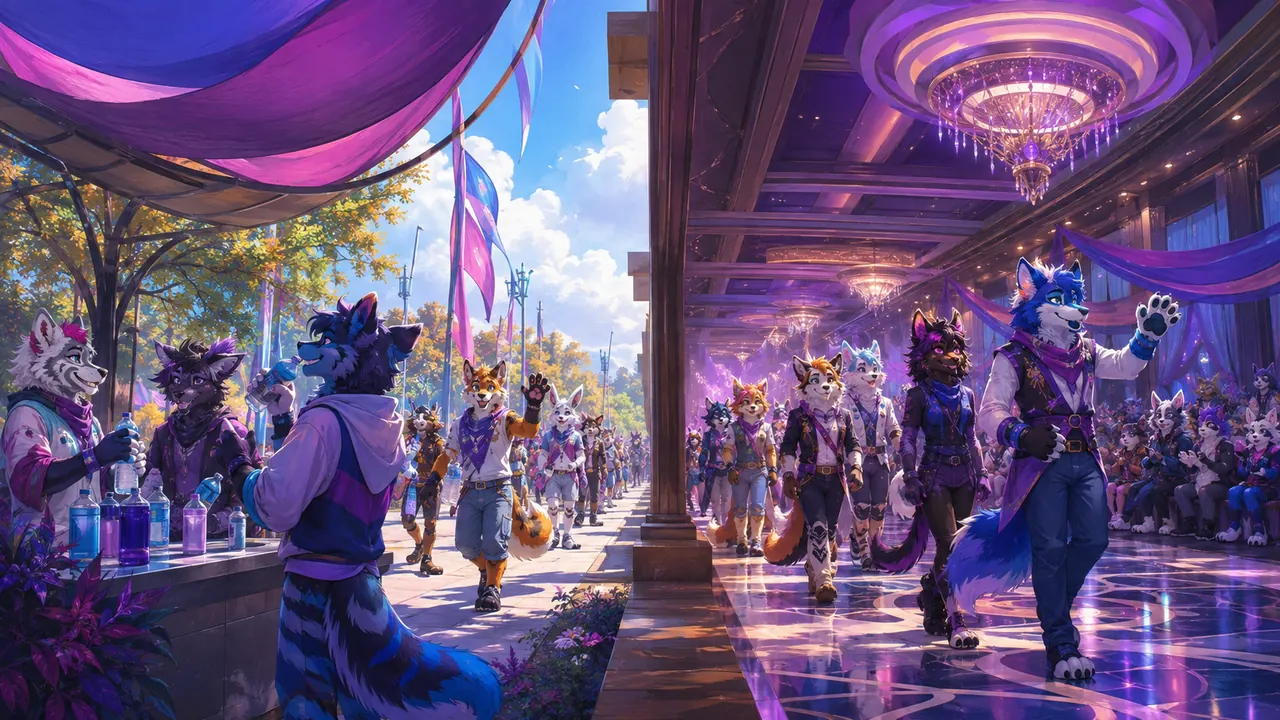
Rechecked five organizer/community sources for the parade comparison; distinguished elapsed September 5 plans from observed execution. Preserved historical reporting and cancellation context without inventing attendance or outcomes. Replaced the hero with an article-specific, credited AI-generated conceptual illustration; reporting and source-review dates are unchanged.
Read our sourcing, AI-assistance, and corrections policy.
Source links recorded for this article
- San Antonio Furs September 2026 events
- San Japan 17 official homepage
- IndyFurCon Fursuit Photo and Menagerie
- IndyFurCon FAQ
- Furry Migration 2026 parade update
- Anthro New Mexico About and FAQ
- Anthrocon 2026 parade and block party update
- Mello Zone Anthrocon parade heat-plan analysis
- Mello Zone IndyFurCon accessibility report
- Mello Zone Anthro New Mexico opening-day report
- Mello Zone event safety guidelines