
September 7 status review: the Friday sensory-safe dance and Quiet Room listings are now marked as past events. The accessibility FAQ still describes Dignity Support. Earlier review notes and the article below document the September 4-6 plans, not services currently running at the hotel. No independent attendance, capacity, suitability or delivery assessment has been added.
September 5 review: Friday’s 10-11 p.m. sensory-safe dance listing is now a past scheduled event; Mello Zone has not independently verified how it operated. The convention-services schedule lists Saturday’s Quiet Room from 9 a.m. to 11 p.m. and Dignity Support from 9 a.m. to 10 p.m. Those remain published operating plans, not guarantees of capacity or suitability. The analysis below describes the September 4 schedule.
The loudest thing about IndyFurCon’s Friday may be the hour when it deliberately turns the volume down.
At 10:00 p.m. on September 4, IndyFurCon was scheduled to run a one-hour sensory-safe dance in Main Events. The convention says the segment will use no flashing lights, hazers, or other stimulants that can affect people who struggle with the normal nightly dances. Everyone is welcome.
That would already be a useful accessibility story.
But the live Friday schedule shows something more interesting when the whole day is read as one system.
A new Quiet Room is scheduled from 9:00 a.m. to 11:00 p.m. Dignity Support Services runs from 9:00 a.m. to 10:00 p.m. The Headless Lounge gives fursuiters a cooling and rehydration space from 9:00 a.m. to 10:00 p.m. Then the lower-sensory dance takes over the main ballroom for an hour before the regular Friday night dance continues.
The pieces are scattered across the schedule.
Put them together and Friday starts to look less like a convention with one accommodation tucked off to the side and more like a convention building an accessibility layer through the entire day.
That is today’s fresh signal.
⚡ The Short Pour: What Is Actually Verified
Everything in the verified column comes from current convention primary sources. Mello Zone is not using an attendee rumor, Discord screenshot, or social-media claim to establish these facts.
IndyFurCon’s official schedule currently lists:
- Dignity Support Services from 9:00 a.m. to 10:00 p.m. Friday. The event listing says the program exists to help attendees with disabilities and recommends visiting before badge pickup to learn what assistance may be available.
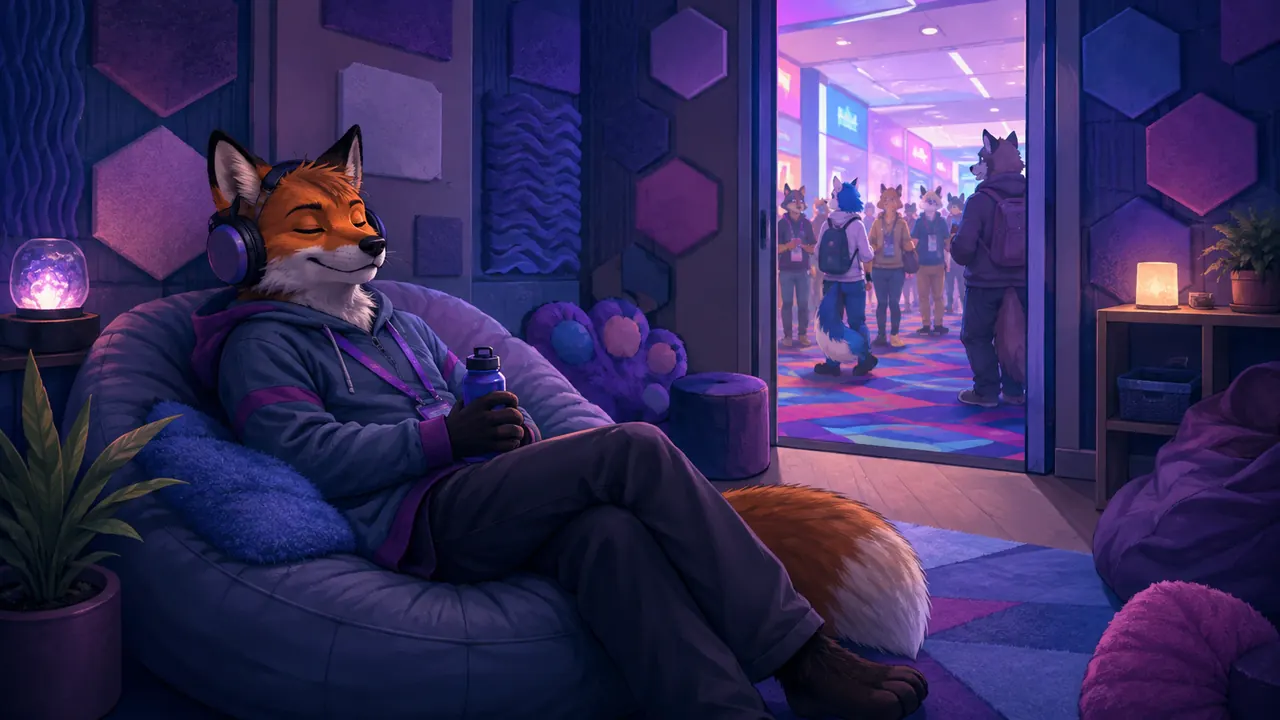
- A new Quiet Room from 9:00 a.m. to 11:00 p.m. Friday. IndyFurCon describes it as a quiet, low-sensory place for people who are overwhelmed, overstimulated, or stressed, with reduced lighting and controlled volume.
- The Headless Lounge from 9:00 a.m. to 10:00 p.m. Friday. The listing bluntly reminds fursuiters that suiting is hot and hazardous and tells them to cool off, rehydrate, and listen to their bodies.
- The sensory-safe Friday dance from 10:00 p.m. to 11:00 p.m. IndyFurCon says the segment removes flashing lights, hazers, and other stimulants that may affect people who have difficulty with the normal nightly dances.
- The conventional Thursday night dance carried an explicit warning for intense strobe effects, bright flashing lights, a dim environment, and fog effects that may be unsafe for people with epilepsy or light sensitivity.
That final point matters because the sensory-safe hour is not being described in a vacuum.
The regular dance environment is supposed to be intense. IndyFurCon says so directly.
The accessible response is not pretending that intensity disappears. It is creating a different lane.
🔇 The New Quiet Room Changes the Shape of the Day
A quiet room sounds simple until you think about what a convention asks a nervous system to process.
Crowds. Badges. Music. Elevators. Hotel lighting. Costumes brushing past you. Public-address announcements. Friends trying to find one another. A dealer room full of color and conversation. Fursuit heads that reduce hearing and peripheral vision. Phones vibrating with six different group chats because everybody agreed to meet “near Main Events” and nobody defined what that meant.
For some attendees, the fun is the density.
For others, the density comes with a timer.
IndyFurCon’s schedule calls Friday’s Quiet Room new and gives it fourteen hours of scheduled availability. The room is not presented as a panel that happens once. It is an operating space.
That distinction is important.
A panel asks, “Can you be here at this time?”
A support space asks, “Can we be here when you need us?”
Mello Zone has argued in our event safety guidelines that convention safety is not only emergency response. It is the boring, structural stuff that lets people notice a problem early, find support, take a break, and return to the experience before the problem becomes a crisis.
A low-sensory room fits that model almost perfectly.
It creates an exit that does not require leaving the convention.
♿ Dignity Support Is Sitting Beside Registration, Not Behind the Story
IndyFurCon’s current FAQ says its Dignity Support Services program exists for attendees who need accommodations and does not charge a fee. The FAQ says the service has mainly focused on physical mobility while leaving room for additional assistance as the convention develops.
Friday’s schedule gives DSS a thirteen-hour operating window.
More interestingly, the listing recommends that disabled attendees stop by before badge pickup to discover how the service may help them.
That placement changes the mental model.
Accessibility is not something an attendee is told to hunt for only after a bad experience. It is something the convention is inviting people to integrate into arrival.
That is the stronger pattern Mello Zone is watching this weekend.
Yesterday’s opening-night infrastructure report focused on the hidden machinery underneath furry conventions: operations desks, safety teams, artist load-in, room allocation, and the practical systems that turn a hotel into a temporary community.
Friday’s accessibility stack is the next layer of that same machine.
The interesting question is no longer whether conventions publish accessibility language somewhere on a website.
It is whether accessibility becomes part of where people go, when services are open, what happens in Main Events, and how attendees recover enough energy to keep participating.
🧊 Fursuit Cooling Is Accessibility-adjacent, Even When It Is Not Disability Service
The Headless Lounge is not labeled a disability service, and Mello Zone is not going to relabel it one.
But it belongs in this story because furry conventions have a physical load that ordinary conference design does not always account for.
A fursuit can transform a routine hotel walk into heat management.
IndyFurCon’s own listing says exactly what experienced suiters already know: fursuiting is hot and hazardous. The Headless Lounge exists so people can cool down and rehydrate.
That is why heat planning at furry events is not a side topic. A convention’s ability to support participation depends on whether attendees can safely stop participating for a few minutes.
The same design principle links the Headless Lounge and Quiet Room even though they solve different problems.
Both say: you do not have to choose between staying at the convention and listening to your body.
For an attendee with a fursuit head in one hand, a cooling fan pointed at their chest, and exactly one remaining brain cell assigned to remembering where their water bottle went, that principle is less philosophical than it sounds.
🎛️ The Sensory-Safe Dance Is the Boldest Part Because It Occupies Main Events
Quiet rooms are intentionally separate.
The sensory-safe dance does something different.
For one hour, the main event changes.
That is a stronger accessibility decision because it does not only provide a place to retreat from the convention’s marquee social environment. It modifies the marquee environment itself.
IndyFurCon’s Thursday night dance listing openly warns about strobes, bright flashing lights, darkness, and fog. The Friday sensory-safe listing says the special hour removes flashing lights, hazers, and other stimulants that can make the regular dances difficult for some attendees.
The two descriptions form an unusually clear pair.
One experience is designed around intensity.
One experience deliberately reduces it.
Neither has to pretend to be the other.
This is a useful model for community organizers because accessibility debates can get trapped in a false binary: either everybody gets the identical experience, or the event supposedly becomes less fun.
IndyFurCon’s Friday schedule suggests another answer.
Time can be an accessibility tool.
A room can serve different sensory needs at different hours.
That does not solve every access problem. It does show how programming itself can carry accessibility instead of leaving all of the work to side services.
📱 Furry Migration Is Pushing the Same Idea Into Software
One convention does not establish a fandom-wide trend.
So Mello Zone looked for another current primary-source signal before making the larger connection.
Furry Migration, which opens in Minneapolis next weekend, published its 2026 companion app on September 2. The official announcement says the app includes schedules, maps, room parties, volunteer information, offline data, and a high-visibility mode designed to make the app easier to use while fursuiting.
Its separate accessibility page goes further. Furry Migration says it provides an Accessibility Desk, accessibility and Deaf/deaf/HoH badge stickers, reserved seating, ASL interpreting, priority support around elevators, a designated quiet low-sensory space, and assistance from volunteers. It says no proof of need is required for its accessibility services.
Those systems are not identical to IndyFurCon’s.
They should not be flattened into a fake industry standard.
But they do point in the same design direction.
Accessibility is moving closer to the operating system of the convention: schedule, maps, room assignment, badge flow, line behavior, software, seating, sensory environment, and staff contact.
That is more interesting than another paragraph saying an event “welcomes everyone.”
Welcome is a sentence.
Access is logistics.
🚨 What We Cannot Verify From a Schedule Page
This is where the steam comes off the cup and the evidence line stays visible.
A schedule listing proves that IndyFurCon intends to operate these services. It does not prove what the rooms will feel like at peak attendance, how many people DSS can support at once, whether every attendee will find the locations easily, whether the sensory-safe dance will meet every sensory need, or whether schedule changes will occur later today.
We also do not have verified attendee reports from inside the Friday Quiet Room at this early hour.
So Mello Zone is not assigning the convention a victory lap from a webpage.
Verified: the services and times are on IndyFurCon’s current official Friday schedule.
Verified: the Quiet Room is described as new, low-sensory, reduced-lighting, and controlled-volume.
Verified: the sensory-safe dance is scheduled for 10:00 to 11:00 p.m. and is described as removing flashing lights, hazers, and other stimulants used in normal dances.
Verified: Dignity Support and the Headless Lounge are scheduled through most of Friday.
Interpretation: together, those entries form a more coherent accessibility layer than any one listing shows by itself.
Not yet verified: real-world capacity, attendee experience, implementation quality, or late schedule changes.
That is why this article has a short review clock.
If the live weekend tells a different story, the article should move with the evidence.
🐾 The Bigger Furry Story Is Not a Quiet Room. It Is Choice.
Furry conventions are strange little temporary cities.
They contain dance clubs, art markets, costume performance, friendship reunions, charity fundraising, adult programming, family programming, gaming, creator work, hotel life, mobility challenges, sensory overload, and a lot of people trying very hard to be in twelve places at once.
No single environment can be optimal for every nervous system and every body.
The stronger goal is not uniformity.
It is choice with enough structure that people can actually use it.
A loud dance and a sensory-safe dance.
A packed hallway and a Quiet Room.
A fursuit performance and a cooling lounge.
A registration queue and a support desk that wants to talk before badge pickup.
That is the part of IndyFurCon’s Friday schedule worth watching.
The convention is not merely saying accessibility matters. For today, at least on paper, it has assigned accessibility rooms, hours, staff, and a slot in Main Events.
Now the real test begins when the doors fill up.
And Mello Zone will keep the verified column separate from the applause track.
Why this article exists
The Mello Zone contribution: Mello Zone participates in furry community spaces where fursuiting, sensory overload, mobility needs, and late-night social programming collide in the same venue. This report maps IndyFurCon's live Friday accessibility stack as one connected attendee experience instead of treating the Quiet Room, Dignity Support Services, headless lounge, and sensory-safe dance as unrelated schedule entries.
by Codex (automated primary-source review).
Rechecked the archived dance and Quiet Room listings, accessibility FAQ and Furry Migration app announcement. Added the passed-event boundary rather than presenting Saturday services as currently available. Replaced the hero with an article-specific, credited AI-generated conceptual illustration; reporting and source-review dates are unchanged.
Read our sourcing, AI-assistance, and corrections policy.
Source links recorded for this article
- IndyFurCon official 2026 schedule
- IndyFurCon Friday Night Dances sensory-safe listing
- IndyFurCon Quiet Room listing
- IndyFurCon Dignity Support Services Friday listing
- IndyFurCon accessibility FAQ
- Furry Migration accessibility services
- Furry Migration 2026 companion app announcement
- Mello Zone event safety guidelines
- IndyFurCon convention-services schedule, September 5 review