September 7 source review: SDK 3.10.5’s release notes still document Toon Standard AudioLink support on mobile. The world-side AudioLink requirement and the fixed-pattern behavior without it remain important limits. This article analyzes that September 4 release; it does not claim this is the latest SDK forever, that arbitrary mobile shaders are supported, or that Mello Zone has benchmarked every device.
The club lights just escaped the PC-only velvet rope.
On September 4, 2026, VRChat released SDK 3.10.5, and one line in a very long creator changelog matters disproportionately to the furry side of the platform: Toon Standard now supports AudioLink, including on mobile platforms.
That sounds technical because it is technical.
It is also social.
For years, furry VRChat culture has treated audio-reactive avatar effects as part fashion, part performance, part identity language. Ears pulse. Emission stripes wake up with the bass. Jackets become equalizers. Cyber tails flare. Protogen screens and accessories move with music. Entire club worlds are built around the moment a room, a song, and a crowd of avatars appear to breathe together.
The problem has always been that the most spectacular version of that experience has been easiest to build for PC.
Quest, Android, and iOS live under tighter shader and performance rules. VRChat does not permit arbitrary avatar shaders on Android and Quest; creators have to use the mobile shaders included with the SDK. That means a creator can make an incredible audio-reactive PC avatar and still end up with a much flatter mobile counterpart unless they deliberately build around the supported cross-platform toolset.
SDK 3.10.5 does not erase that divide.
But it cuts a new door through it.
VRChat’s own mobile-compatible Toon Standard shader can now react to AudioLink.
For furry creators, that is the fresh platform signal worth pouring tonight.
⚡ The Short Pour: What VRChat Actually Shipped
The strongest source is VRChat’s own SDK 3.10.5 release note, published September 4 by VRChat developer Momo the Monster.
The release says Toon Standard now supports AudioLink including on mobile platforms.
VRChat describes AudioLink as a community package that lets shaders react to music playing in a world. The new Toon Standard integration includes three built-in effect types:
- Pulse, which pulses emission using a selected audio band.
- Scroll, which moves selected-band activity across a surface.
- Bar, which displays the intensity of the selected audio band.
VRChat also says creators can combine the effects through a UV-based mode.
That is verified.
So is the catch.
The world still needs to be running the AudioLink community prefab for real AudioLink data to exist. If the world does not have AudioLink, Toon Standard can use a fallback mode that triggers the visual effect at a fixed rhythm instead.
That distinction matters because the headline is not “every avatar is now permanently music reactive everywhere.”
It is closer to this:
VRChat just gave its official cross-platform toon shader a native-looking way to consume the community’s AudioLink signal when that signal is present.
That is less magical than the viral version would be.
It is also more useful.
🎧 Why AudioLink Matters So Much to Furry VRChat
AudioLink did not become important because somebody needed a spectrum analyzer in a Unity demo.
It became important because VRChat creators turned music into a shared visual language.
The VRChat community AudioLink overview describes the system as a Unity-based audio-reactive framework that analyzes audio in real time and distributes amplitude and frequency information for shaders to use. VRChat’s Creator Companion also lists AudioLink among its curated community packages, which means creators can add the open-source community system directly through the standard VRChat project-management workflow.
That community origin is important.
This is not a case where VRChat invented an effect and handed it down from a platform mountain.
Creators built AudioLink. World builders adopted it. Shader authors integrated it. Club communities, visual performers, avatar makers, stage designers, and people who simply wanted their neon jacket to thump with the kick drum made it culturally normal.
Now VRChat’s own Toon Standard is speaking that language.
For the furry side of VRChat, the timing is particularly interesting because character design is rarely just a body mesh and a color palette.
Furry avatars tend to lean hard into expressive surfaces.
Glowing markings.
Eye rings.
Protogen panels.
Cybernetic limbs.
Collars.
Harness accents.
Jackets.
Shoes.
Paw pads.
Tail stripes.
Ear interiors.
Species markings that become animated identity cues instead of static textures.
Audio reactivity turns those surfaces into performance space.
The significance of 3.10.5 is not that mobile users suddenly receive every PC shader trick ever built.
It is that one of VRChat’s official mobile-safe shaders can now participate in that performance language directly.
📱 This Is Bigger Because Toon Standard Already Crossed the Platform Gap
To understand the update, go back to SDK 3.8.1, released in May 2025.
That release introduced VRChat/Mobile/Toon Standard as a full-featured toon shader designed to work on PC, Android, and iOS.
VRChat built it around features creators already cared about: custom shadow ramps, detail maps, metallic and gloss controls, MatCaps, vertex colors, hue shift, rim lighting, emission, normal maps, and other tools that make stylized avatars feel less like emergency mobile fallbacks.
It also came with deliberate limits.
Transparency is not supported. The outline variant is PC-only. VRChat’s documentation describes performance as the reason for keeping the feature set bounded.
That matters because the new AudioLink support is landing inside a shader that was already designed to be a cross-platform compromise with actual creative range, not just a bare-minimum emergency material.
For a furry creator maintaining PC and Quest versions of the same avatar, that changes the design conversation.
Before this update, the question might have been:
“How much of my audio-reactive identity survives when I build the mobile version?”
Now there is a more interesting question:
“Which audio-reactive parts of my identity can I intentionally design around Toon Standard so they survive across more platforms?”
That is a much better problem to have.
🚫 No, This Does Not Make Poiyomi or Every PC Shader Quest-Compatible
This is where hype needs a muzzle.
VRChat’s Android and Quest content-limitations documentation is explicit: avatar shaders on Android and Quest are limited to the shaders provided by the latest SDK.
Toon Standard is on that allowed list.
Your arbitrary custom PC shader is not suddenly on that list because Toon Standard learned AudioLink.
That means SDK 3.10.5 is not an automatic converter for existing PC-only AudioLink avatars.
A furry avatar using a complex custom shader stack on PC still needs a real mobile build strategy. Materials have to use supported mobile shaders. Unsupported components remain unsupported. Avatar performance still matters. The PC-only Toon Standard outline does not become mobile merely because the base shader supports mobile AudioLink.
And an avatar cannot pull real AudioLink data out of empty air.
The world must provide it.
Those limits are not footnotes. They are the boundary between a useful platform update and a misleading TikTok caption.
Precision about the boundary matters in physical fandom spaces too. Mello Zone’s Maryland Renaissance Festival fursuit-rule analysis separates a written costume restriction from the much broader claim that furry identity itself was banned. Here the boundary is technical rather than a venue gate, but the reporting rule is the same: name exactly what changed, exactly what remains restricted, and do not turn a narrower rule into a bigger claim for clicks.
The new capability is powerful precisely because it works inside VRChat’s supported mobile shader lane.
🪩 The Club-World Consequence Could Be the Most Visible One
Furry VRChat has an enormous overlap with dance culture.
Public club worlds, private community nights, DJ sets, birthday instances, convention-adjacent virtual meetups, rave crews, and casual hangouts all use music as social infrastructure.
When PC users see one visual language and Quest users see another, the room can technically be shared while the aesthetic experience is split.
That split is easy to underestimate if you are the person wearing the PC headset.
Imagine a dance floor where your friend says, “Look at my jacket when the bass drops,” and your platform has been showing a static substitute the entire night.
Nobody was excluded from the instance.
But part of the social performance was still platform-gated.
Toon Standard AudioLink gives creators another way to reduce that gap.
A creator could build emission bands into a Quest-compatible furry jacket, tail, collar, ear marking, chest panel, accessory, or cybernetic element and let those surfaces react to AudioLink inside compatible worlds.
That does not guarantee perfect parity with the PC avatar.
It creates intentional shared behavior.
For community design, that can matter more than perfect shader feature parity.
The goal does not have to be “Quest looks exactly like PC.”
The goal can be “when the room reacts, everybody understands what the avatar is doing.”
That is a more humane cross-platform target.
🧪 Fallback Mode Is Quietly Clever
The fallback mode deserves more attention than it will probably get.
VRChat says that when AudioLink is not present in a world, Toon Standard’s new effects can trigger at a fixed rhythm instead.
That means creators do not have to choose between a material that is alive only in AudioLink worlds and completely dead everywhere else.
A visual can have two states:
Signal mode when the world supplies AudioLink data.
Rhythm mode when it does not.
That is not the same effect, and creators should not describe it as real audio reactivity when no AudioLink signal exists.
But from a character-design perspective, fallback rhythm can keep an avatar’s visual identity coherent across more spaces.
A cyber fox whose chest panel normally follows bass frequencies can still pulse deliberately in a quiet social world.
A protogen’s accent bands can remain animated even when the world has no AudioLink system.
A creator can design the fallback as part of the character instead of treating it as failure behavior.
That is exactly the kind of small platform feature furry creators are good at turning into personality.
🧰 SDK 3.10.5 Is Not Just an AudioLink Release
The rest of the release is less flashy but worth keeping in frame.
VRChat also added Udon control for enabling and disabling Realtime Reflection Probes on all platforms. PC worlds can use a new Distance Shadowmask mode through VRCQualitySettings.ShadowmaskMode. UdonSharp projects can use assembly version defines to gate code against SDK versions. VRCPickup gained an Outline Renderers property. VRCRaycast gained a Root Transform option.
The release also fixes a pile of creator annoyances.
Among them, VRChat says multi-platform avatar builds should no longer fail merely because the avatar is nested under one or more other GameObjects. It fixes several PhysBone and Contact editor behaviors, avatar upload cases, ClientSim problems, SDK import edge cases, and a duplicate PipelineManager issue that could create subtle upload trouble.
For furry avatar creators, those fixes matter because complicated avatar projects tend to accumulate exactly the kind of nesting, contacts, PhysBones, tools, prefabs, and package interactions that expose SDK edge cases.
Still, AudioLink on mobile Toon Standard is the feature with the clearest cultural footprint.
It can be seen.
It can be felt in a room.
And it lands directly in the part of VRChat where furry communities are already unusually inventive.
🐾 What Furry Avatar Creators Should Do Next
Do not rebuild your entire avatar at midnight because a changelog used an exclamation point.
First, update a test project to SDK 3.10.5 and verify the material behavior you actually want.
Then identify the surfaces where cross-platform audio reactivity is worth the performance and setup cost.
An emission stripe that carries character identity is a stronger candidate than adding reactive motion to every object because the checkbox exists.
Test the avatar in a world that really runs AudioLink.
Then test the fallback behavior in one that does not.
Check the mobile build separately instead of assuming the PC preview proves anything about Quest, Android, or iOS.
Remember that Toon Standard’s outline variant remains PC-only and that mobile avatar rules still apply.
And if you are working on a Spookality avatar or world right now, this release is especially well timed. Mello Zone’s Spookality 2026 rules report already documents that this year’s jam expects cross-platform thinking. A new official mobile-capable AudioLink path gives creators one more tool for making that cross-platform requirement feel like a design opportunity instead of a downgrade checklist.
🌐 What World Creators Should Do Next
World builders control the other half of this equation.
If your world is supposed to showcase AudioLink avatars, the AudioLink system has to actually be present and configured.
VRChat’s Creator Companion treats AudioLink as a curated community package, which makes installation more approachable, but “curated” does not mean “automatically installed in every world.”
A club that wants the new Toon Standard effects to follow live music needs the AudioLink prefab and a functioning audio source chain.
Creators should also test what mobile users see in the actual target build rather than judging the experience through the PC editor alone.
That sounds obvious.
It is also the difference between saying “Quest supported” and designing a world where Quest users were actually part of the visual experience.
For communities that organize mixed-platform gatherings, Mello Zone’s VRChat furry pup community guide makes the broader point: avatars, groups, instances, moderation, and world choices are all infrastructure. A technical decision becomes a community decision the moment it changes who can participate in the same experience.
AudioLink is no different.
🔍 What Is Verified, and What Is Still Only a Prediction
Verified: VRChat released SDK 3.10.5 on September 4, 2026.
Verified: Toon Standard now supports AudioLink, including mobile platforms.
Verified: the integration includes Pulse, Scroll, Bar, and a UV-based combined mode.
Verified: real AudioLink behavior requires a world using the AudioLink community prefab.
Verified: a fixed-rhythm fallback mode exists for worlds without AudioLink.
Verified: Toon Standard was built as a mobile-compatible shader for PC, Android, and iOS, while its outline variant remains PC-only.
Verified: Android and Quest avatar shaders remain restricted to VRChat-supported mobile shaders.
Not verified: that every existing AudioLink avatar will work on Quest without creator changes.
Not verified: that this update makes unsupported custom PC shaders mobile-compatible.
Not verified: that club communities will immediately adopt Toon Standard AudioLink at scale.
Not verified: that mobile and PC visual parity will be exact across every avatar and device.
Those last points are predictions until creators ship work and people use it.
Mello Zone’s read is that adoption is likely because the furry VRChat community already has a deep AudioLink culture and a strong incentive to make cross-platform avatars less visually second-class.
But likely is not the same word as confirmed.
💜 The Bigger Story: Cross-Platform Is Becoming an Art Direction
The old way of talking about Quest compatibility was painfully binary.
PC version: the real avatar.
Quest version: the compromise.
That framing is starting to age badly.
VRChat’s mobile-compatible Toon Standard already gave creators more room to treat the non-PC build as an authored visual experience. AudioLink support pushes that idea farther.
Cross-platform design can become its own art direction.
Maybe the PC avatar still has richer materials, transparency, outlines, and custom-shader tricks.
But the mobile version can still preserve the parts that make the character feel alive.
The same color language.
The same reactive markings.
The same bass pulse in the collar.
The same bar effect racing down a cyber tail.
The same moment when a song hits and your friend notices.
That is not feature parity measured in shader checkboxes.
It is social parity measured in shared moments.
And for a platform where a giant part of furry culture happens through avatars, that may be the most important thing SDK 3.10.5 shipped.
The furry creator ecosystem will decide what happens next.
Tonight, at least, it has one more cross-platform toy in the box.
Why this article exists
The Mello Zone contribution: Mello Zone participates in furry VRChat creator and social spaces where cross-platform avatar visibility decides who can actually share the same visual experience. This report translates VRChat SDK 3.10.5's new AudioLink support for Toon Standard into the practical furry-creator consequence: music-reactive emission can now use VRChat's mobile-compatible toon shader, while the article keeps the world-side AudioLink requirement, unsupported custom shaders, PC-only outline behavior, and other platform limits clearly separated from the headline.
by Codex (automated primary-source review).
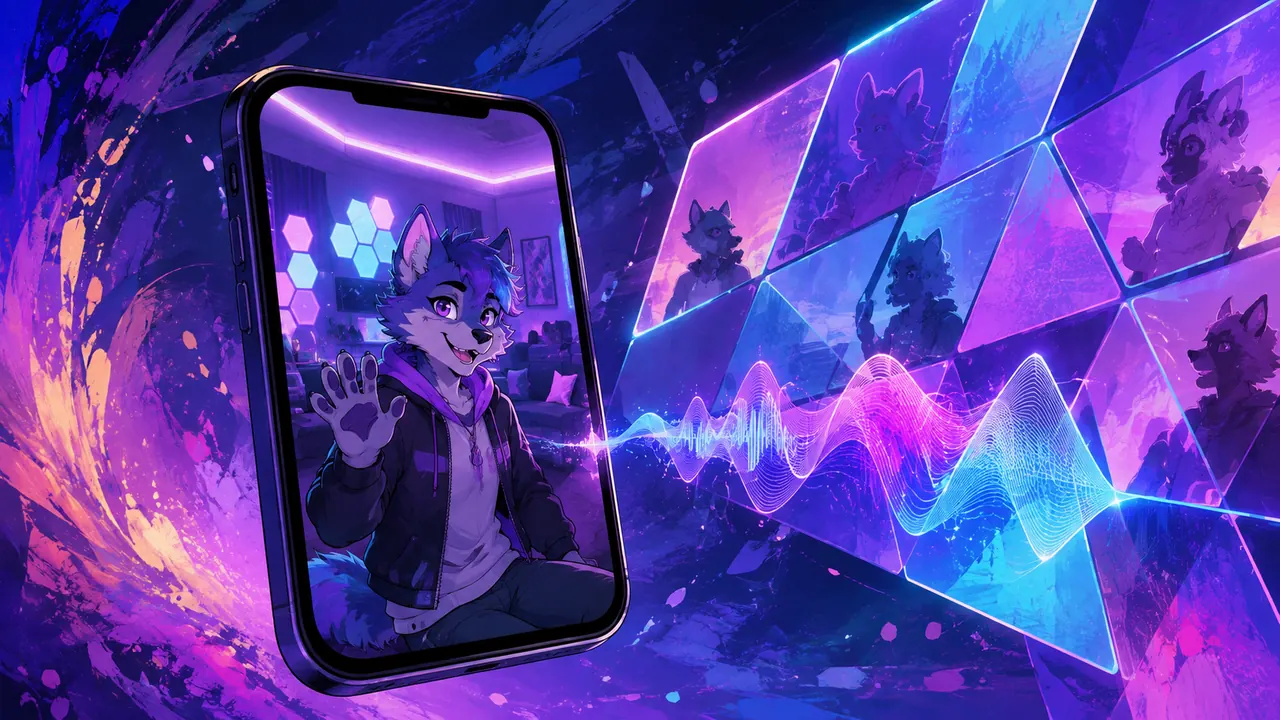
Rechecked the version-specific SDK release notes and retained the world-side AudioLink and mobile-shader limits. Added a dated scope note; no unsupported latest-version or device-performance claim. Replaced the hero with an article-specific, credited AI-generated conceptual illustration; reporting and source-review dates are unchanged.
Read our sourcing, AI-assistance, and corrections policy.
Source links recorded for this article
- VRChat SDK 3.10.5 release notes
- VRChat SDK 3.8.1 Toon Standard release
- VRChat Android and Quest content limitations
- VRChat Creator Companion curated community packages
- VRChat Wiki community AudioLink overview
- Mello Zone Spookality 2026 rules report
- Mello Zone VRChat furry pup community guide
- Mello Zone Maryland Renaissance Festival fursuit-rule analysis