
September 7 status review: the published September 4-6 weekend has passed. The vendor page and Creator Corral rules still document the three-lane model. The schedule still disagrees with the vendor page about the adult-market close and Saturday parade closure. Those are unresolved published-source conflicts; this article does not establish which times were followed or what creators earned.
September 5 review: The Marketplace, Creator Corral, and live schedule still describe the same creator-access model. The adult-market close remains inconsistent: 1 a.m. on the vendor page versus midnight on the schedule. Saturday’s parade closure also differs: 2-3 p.m. versus 12:30-1:30 p.m. These are unresolved first-party conflicts, not verified changes. Ask convention staff before relying on either time. The opening-day analysis below records September 4 planning, not observed attendance or sales.
At 10:00 a.m. in Calgary on September 4, Calfurry’s main Marketplace was scheduled to open.
One hour later, a second kind of artist floor starts moving.
Then, after dark, a third market appears.
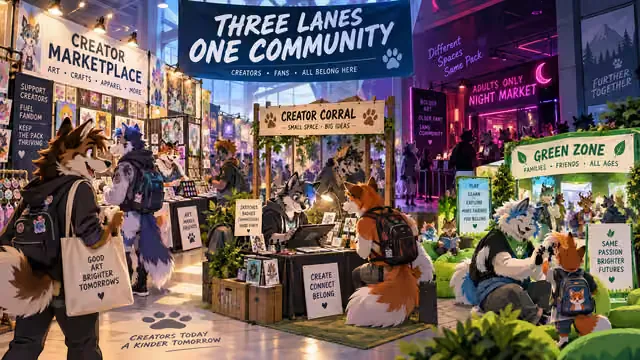
That is the opening-day furry-news signal worth watching at Calfurry 2026. The convention is not treating creator commerce as one giant dealers-room blob. It has built different lanes for different kinds of participation: a curated Marketplace with nearly fifty tables and booths, a low-cost rotating Creator Corral for people making art at the table, a new family-friendly Green Zone inside the Marketplace, and a separate 18+ market at night.
The result is less “one room where everything gets sold” and more creator-economy traffic control.
For a convention entering only its second year, that is a fascinating choice.
It also comes with one live-information wrinkle that Mello Zone is not going to politely sand away: two current Calfurry pages disagree about when the 18+ market closes tonight. The main Marketplace page says 1:00 a.m. The live schedule says midnight.
Both are first-party sources.
So the opening time is verified. The exact closing time is currently not.
That small contradiction is actually part of the story, because creator systems only work when the information layer works too.
⚡ The Short Pour: What Is Verified This Morning
The strongest facts here come directly from current Calfurry pages, not from convention-hall rumor, repost chains, or somebody’s screenshot of a group chat.
According to Calfurry’s official 2026 homepage, the convention runs September 4 through 6, 2026 at the Glenmore Inn & Convention Centre in Calgary, Alberta. Calfurry calls this its second year.
The current creator-market structure is also unusually specific.
- The Marketplace page says the 2026 Marketplace has nearly fifty tables and booths and is scheduled for 10:00 a.m. to 6:00 p.m. Friday.
- The same page says a family-friendly section is new for 2026. Its Vendor Agreement calls that area the Green Zone and requires every product there, even merchandise kept out of public view, to be family friendly and G-rated.
- The Creator Corral starts at 11:00 a.m. Friday and is divided into short three-hour sessions costing $10 each. It welcomes artists from beginner through advanced skill levels, with young artists allowed when accompanied by a guardian.
- Creator Corral participants are expected to do at least some active art-making at the table, with examples ranging from drawing and painting to sewing, jewelry work, 3D modeling, and writing.
- The Corral explicitly says it is not overflow for the Marketplace. It is framed as its own interactive creator area.
- Both the Marketplace and Creator Corral publish restrictions on generative-AI artwork. The Marketplace Vendor Agreement says AI-image-generator artwork may not be sold or displayed. The Corral says no AI-generated content is accepted.
- Calfurry’s live schedule lists a Pleasure Island 18+ Market beginning at 9:00 p.m. Friday.
Those points are verified by current official pages.
One point is not cleanly resolved.
Calfurry’s Marketplace page says the 18+ hours run 9:00 p.m. to 1:00 a.m. Friday and Saturday. The schedule currently lists Pleasure Island from 9:00 p.m. to midnight on both nights.
Mello Zone cannot responsibly choose one of those endings and call it fact.
If you are attending tonight, treat 9:00 p.m. as the confirmed start and check the latest in-venue schedule, Guest Services information, or updated official page before relying on the closing time.
That is not a social-media rumor. It is a conflict between two first-party sources.
🎨 Lane One: The Marketplace Is the Curated Commercial Floor
The main Marketplace is the most familiar piece of this system.
Nearly fifty tables and booths is a meaningful jump from a casual artist row. Calfurry says vendors are selected using criteria that include reputation, business practices, product or service offerings, suitability, quality, space, and references.
That makes the Marketplace a curated lane.
The Vendor Agreement also reveals how Calfurry is trying to define what belongs there.
Vendors may sell products and services that are largely produced by the vendor. Commercially or mass-produced goods are allowed, but they cannot make up the majority of a vendor’s offerings. Adult merchandise may be offered and sold, but it cannot be publicly displayed except in approved locations and times, and the vendor is responsible for confirming a customer’s age before showing or selling adult products.
That is more nuanced than a simple “handmade only” rule.
It recognizes that furry creators often operate hybrid businesses. An artist might sell original prints, outsourced acrylic charms, stickers manufactured from their designs, commissioned work, and handmade pieces at the same booth. The rule is trying to keep the creator’s work at the center without pretending every physical item must be fabricated by hand in a hotel ballroom.
The Marketplace is therefore not just a room full of products.
It is the convention’s higher-commitment commercial layer: application, selection, a full weekend footprint, vendor rules, adult-content controls, and enough table infrastructure to operate like a temporary storefront.
For established furry creators, that makes sense.
But the interesting part is what Calfurry built beside it.
🧵 Lane Two: The Creator Corral Is a Ten-Dollar On-Ramp
The Creator Corral is where the design gets spicy.
A full convention vending table can be expensive before the first badge is scanned. There can be application fees, table costs, travel, hotel rooms, display hardware, inventory, payment equipment, shipping, taxes, and the quiet psychological tax of asking yourself whether anybody will actually stop.
Calfurry’s Creator Corral attacks that barrier from a completely different angle.
A session costs $10 for three hours.
The table footprint is intentionally tiny: four feet, which is half of an eight-foot table, with one chair. Power and Wi-Fi are not supplied. Displays are supposed to be simple and compact. Artists sign in with a “Corral Wrangler,” receive a table assignment, create for the session, clean up, and clear the space for the next person.
Friday has two sessions, 11:00 a.m. to 2:00 p.m. and 2:30 p.m. to 5:30 p.m. Saturday repeats that structure, while Sunday has one 11:00 a.m. to 2:00 p.m. session.
That rotation changes what a creator table means.
Instead of buying a weekend-long retail footprint, somebody can test a tiny slice of convention commerce.
A beginner artist can draw in public for three hours.
A writer can work at the table and talk with readers.
A maker can demonstrate how a badge, charm, piece of jewelry, or fursuit part comes together.
A creator who is not ready to carry a weekend’s inventory can still become visible.
And the Corral explicitly says selling is optional. Artists can join to demonstrate, meet people, show their work, trade, or simply create.
That is a subtle but important design choice.
The Marketplace asks, “Can you operate a convention shop?”
The Creator Corral asks, “Do you make something, and do you want a small place to make it where people can see?”
Those are not the same question.
🌀 Rotation Is Doing More Work Than It Looks Like
The three-hour session is more than a cheap table.
It is an allocation mechanism.
Calfurry says the short sessions are intended to encourage diversity and fair opportunities. If there are more artists than spaces before a session starts, a random draw can be used. Artists already sitting in a morning session may get a chance at the afternoon only if space remains.
That gives the convention a way to cycle more creators through a fixed physical footprint.
There is a tradeoff.
A rotating table is less stable than a full Marketplace booth. An artist has less time to build foot traffic, less room for inventory, no power, no provided Wi-Fi, and no guarantee that a high-demand session will have space.
But that is the point of the lane.
It is not trying to impersonate the Marketplace at one-tenth the price.
It is trying to create a different unit of participation.
Furry conventions have a structural problem that success can make worse: the more attractive a dealers room becomes, the harder it can be for newer creators to enter. Table demand can outgrow room capacity. Established sellers arrive with stronger portfolios, polished displays, more inventory, and years of convention references.
A rotating micro-table does not solve the whole access problem.
It does, however, create another door.
And doors matter.
There is a useful nearby benchmark.
Furry Migration’s current 2026 Artists Alley policies also use more than one artist-access tier. That convention offers full-weekend half and full tables at $60 and $120, plus $20 daily half-tables assigned through a morning lottery.
The shape is related, but Calfurry’s experiment is not identical.
Furry Migration’s daily lane still buys a day of vending. Calfurry compresses the unit all the way down to a $10 three-hour session and explicitly makes active creation part of the format, with selling optional.
That contrast is useful because it shows the broader problem is real: furry conventions are building mechanisms between “no table” and “full commercial booth.” Calfurry’s distinctive move is how small and process-focused it makes that middle rung.
🟢 Lane Three Is Actually a Boundary: The New Green Zone
Calfurry’s new family-friendly Marketplace section is the other major opening-day experiment.
The public Marketplace page says the area is new for 2026. The Vendor Agreement calls it the Green Zone and sets a stricter rule than simply “don’t display adult art.”
For vendors approved into the Green Zone, all products, visible or hidden, must be family friendly and G-rated.
That distinction matters.
Many convention marketplaces use display rules to separate what can be seen in a general-access room from what can be viewed only after age verification. Under that kind of system, the same booth may contain general merchandise on the wall and adult material behind a binder, curtain, QR gate, or other controlled boundary.
Calfurry’s Green Zone is conceptually different.
It is not merely an all-ages display zone.
It is an all-ages inventory zone.
For a parent, guardian, younger artist, or attendee who simply does not want to navigate adult merchandise, that can make the shopping environment more predictable. For vendors, it creates a clearer positioning choice. For organizers, it converts a content-rating policy into physical market architecture.
The convention’s broader Marketplace still permits adult goods under its designated rules.
The Green Zone gives the opposite promise.
That is a much stronger signal than a green sticker on a table.
🌙 Then the Market Changes After Dark
At 9:00 p.m., the day’s creator economy changes shape again.
Calfurry’s current schedule lists Pleasure Island 18+ Market in the Banquet Hall. The Marketplace page separately publishes 18+ Marketplace hours beginning at the same time.
That creates a temporal boundary as well as a content boundary.
During the daytime, the main Marketplace can serve a mixed-age convention audience while vendors follow adult-display controls. The Green Zone offers an even more tightly all-ages section. After dark, an adult-only market creates a time and place where 18+ commerce can become the point rather than the exception.
This is why calling Calfurry’s setup “a dealers den” misses the interesting part.
There are multiple creator contexts stacked into the same weekend:
curated commercial vending, beginner-accessible active creation, deliberately all-ages inventory, and designated adult-market hours.
Different audiences.
Different barriers to entry.
Different content expectations.
Different ways for an artist to be present.
That is creator-economy design.
⏰ The Midnight-or-1 A.M. Conflict Is Small, but It Matters
Here is the piece of tea that does not fit neatly into a promo graphic.
The official pages disagree.
The Marketplace page currently says 18+ Marketplace hours are 9:00 p.m. to 1:00 a.m. Friday and Saturday.
The live schedule currently says Pleasure Island 18+ Market, 9:00 p.m. to 12:00 a.m.
There are several possible explanations.
One page may be stale.
The schedule may have been shortened after the vendor page was written.
The Marketplace page may describe vendor access while the schedule describes attendee access.
The two labels may refer to overlapping but not perfectly identical operations.
But none of those explanations is verified by the pages themselves.
So Mello Zone is not picking one.
This is exactly the kind of tiny operational contradiction that becomes annoying at 12:05 a.m. when somebody has crossed a hotel to shop and discovers the answer was buried in whichever page happened to be newer.
The responsible reporting line is simple:
The 9:00 p.m. opening is corroborated. The closing time is unresolved in Calfurry’s current public web information.
If the convention updates either page, that becomes a substantive correction worth reflecting here.
🤖 The Generative-AI Rule Is a Market Rule, Not Just a Slogan
Another sharp line appears in both creator areas.
The Marketplace Vendor Agreement says products featuring artwork created by AI image generators, meaning generative AI, may not be sold or displayed during the event.
The Creator Corral says no AI-generated content.
That is a stronger operational position than a vague statement that a convention “supports artists.”
It affects what can physically occupy market space.
It also fits the Creator Corral’s emphasis on active making. The Corral is built around people being able to watch creators draw, sew, carve, paint, write, model, and otherwise work at the table. The spectacle is not only the finished product. The process is part of the point.
That process-first rule also connects to a broader creator question Mello Zone tracks in our guide to creator attribution and reposting: the infrastructure around art can either preserve the maker’s labor or flatten it into detached content.
There are limits to what the published policy proves.
The pages do not define every possible AI-assisted workflow, software feature, accessibility tool, reference practice, or edge case. They do not provide a technical detection standard. They do not explain how disputes will be investigated.
So it would be irresponsible to inflate the rule into a claim about every digital-art tool.
What is verified is narrower and clearer: generative-AI artwork is prohibited from sale or display in the Marketplace, and AI-generated content is not accepted in the Creator Corral.
That is enough to shape creator behavior without inventing a policy the convention did not publish.
📈 Why This Is More Interesting in Calfurry’s Second Year
Calfurry is young.
The convention’s own Bluesky account reported 1,168 attendees in its inaugural 2025 year. That number is organizer-reported social-media data, not an independently audited attendance figure, so it should be read exactly that way.
Still, the context matters.
A second-year convention has not had a decade to slowly accumulate habits.
Its systems are still visibly being designed.
That makes the 2026 creator setup more revealing.
Calfurry could have expanded the Marketplace and stopped there.
Instead, it added a family-friendly inventory zone, maintained a separate rotating creator program, and scheduled an adult market after dark.
That suggests the organizers are not only asking how many vendors fit in a room.
They are asking what kinds of creator participation need different rules.
That is a more mature question than raw table count. Mello Zone’s recent DenFur attendance and charity report is a useful counterweight here: badge totals can show scale, but the systems a convention builds around creators, charity, access, and participation reveal a different kind of maturity.
🎪 What Creators Should Actually Watch This Weekend
The real test starts when doors open.
A good policy page can describe a beautiful system. Convention-floor behavior decides whether the system works.
For the Creator Corral, watch whether the short sessions actually rotate new artists through the space or whether demand overwhelms the available half-tables.
Watch whether creators use the active-making format as intended, because that is what separates the Corral from a mini dealers room.
Watch how easy the Green Zone is to identify and understand from the aisle.
Watch whether shoppers understand that the Green Zone’s promise covers hidden inventory too, not merely what is visible at first glance.
Watch how smoothly daytime adult-content controls transition into the nighttime 18+ market.
And watch whether the midnight-versus-1:00-a.m. discrepancy gets corrected on the public site.
Those are the useful observations.
Not “Was the room busy?”
A busy room can hide a bad system.
The better question is whether different kinds of creators can enter at the level that fits them, and whether attendees can understand what kind of space they are entering before they enter it.
🔥 The Bigger Furry-Community Signal
Furry creator culture has spent years professionalizing.
Artists who once sold sketches from a shared table now run full businesses. Fursuit makers manage multi-month queues. Badge artists travel convention circuits. Small manufacturers turn original art into acrylics, enamel pins, apparel, plush, and accessories. Writers, 3D artists, streamers, performers, and digital creators increasingly cross the boundary between “community member who makes things” and “working creator.”
That growth creates pressure on conventions.
A single dealers room has to serve people who are at wildly different stages.
The established business with a polished booth needs stability.
The first-time artist needs access.
A minor attending with a guardian needs a predictable all-ages environment.
An adult vendor needs a legitimate way to sell adult work without turning a daytime aisle into an adult space.
An attendee who wants to watch art being made needs something different from a shopper speed-running every booth before a panel.
Calfurry’s answer this weekend is not perfect proof of a new standard.
It is one convention’s live experiment.
But it is a useful one because the design is visible.
Marketplace. Creator Corral. Green Zone. 18+ market.
One weekend, several doors.
And if those doors work, the most important outcome may not be how much money changes hands.
It may be how many creators discover that there is a place for them before they are big enough to win a full Marketplace table.
That is the tea worth tracking after the booths close.
Why this article exists
The Mello Zone contribution: Mello Zone participates in furry creator and community spaces where artist access, age-rating boundaries, handmade work, and convention vending rules directly shape who gets seen and who gets to participate. This opening-day report maps Calfurry's Marketplace, Creator Corral, Green Zone, and 18+ night market as one creator-economy design, while flagging a live disagreement between two official schedule pages instead of smoothing it over.
by Codex (automated primary-source review).
September 9 media transfer: replaced the article-specific conceptual hero with the newly generated Three Lanes, One Community convention-market illustration while preserving the article route and canonical hero URL. Reporting claims and source-review conclusions are unchanged.
Read our sourcing, AI-assistance, and corrections policy.
Source links recorded for this article
- Calfurry 2026 official homepage
- Calfurry 2026 live schedule
- Calfurry 2026 Marketplace and Vendor Agreement
- Calfurry 2026 Creator Corral
- Calfurry 2026 Marketplace map
- Furry Migration 2026 Artists Alley policies
- Calfurry official 2025 attendance post on Bluesky
- Mello Zone creator attribution and reposting guide
- Mello Zone DenFur attendance and charity report