
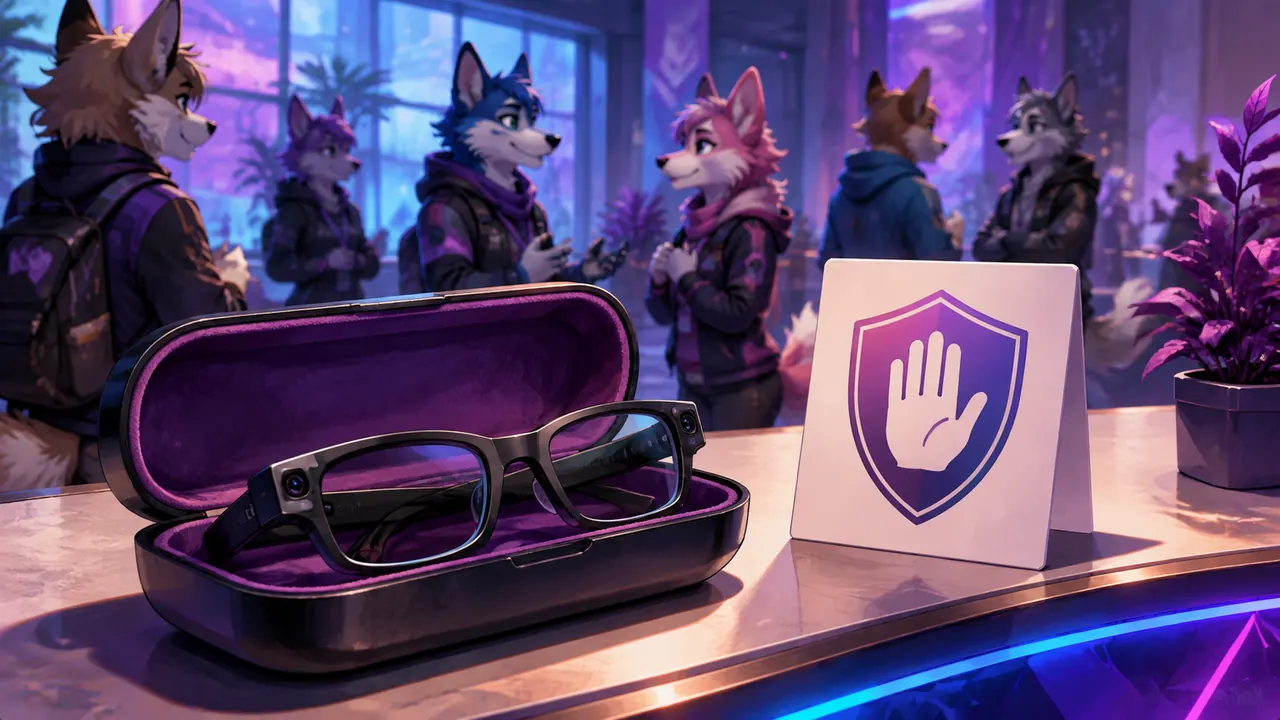
A camera just became part of the dress code conversation.
Late on September 3, Anthro SoCal updated its official attendee policies to prohibit Meta-style glasses with recording capabilities at its 2026 convention. The same policy says surreptitious filming is an invasion of privacy and will be treated as a Code of Conduct violation.
That is not a rumor bouncing through furry social media. It is now written into the convention’s own rules.
And the wording gets sharper from there.
Anthro SoCal says there is no exception for recording glasses fitted with prescription lenses. If someone relies on that pair as everyday eyewear, the convention tells them to bring non-violating eyewear instead. The policy also asks attendees who take pictures to use recognizable personal photo equipment, such as a smartphone, so that their intent is clearer, and to obtain affirmative permission from the faces in frame.
For a fandom where convention hallways are simultaneously social space, performance space, creator space, costume space, and sometimes the only place somebody gets to exist under a chosen name for a weekend, this is bigger than a gadget rule.
It is a fight over whether the act of recording should be visible before the recording starts.
And Anthro SoCal has picked a side.
⚡ The Short Pour: What Anthro SoCal Actually Changed
The verified facts are unusually clean because the primary source is the convention itself.
Anthro SoCal’s attendee-policy page, rechecked on September 7, is now marked Last Updated: 2026-09-06. It still identifies the recording-glasses rule as new on September 3; the prohibition and prescription-eyewear provision remain in place.
The policy establishes all of the following:
- Meta-style glasses with recording capabilities are prohibited at Anthro SoCal.
- Surreptitious filming is described as an invasion of privacy and a Code of Conduct violation.
- Prescription lenses do not create an exception for otherwise prohibited recording glasses.
- Ordinary photography and recording remain allowed in common convention areas, subject to consent and harassment rules.
- Attendees must stop recording or photographing someone when asked to stop.
- Recording 18+ panels or areas is prohibited, including capturing attendees entering or leaving those areas.
- The convention recommends recognizable personal photo equipment, such as a smartphone, when taking pictures.
- It asks photographers to get affirmative permission from people whose faces are in frame.
- Commercial press and publication recording require advance clearance from F.U.R.E.A.L., the organization that operates Anthro SoCal.
- Anthro SoCal itself plans an official livestream with approved staff and professionals in designated open spaces and certain Main Events programming.
That last distinction matters.
The convention is not declaring photography evil. It is drawing a line between visible, consent-aware capture and recording hardware that can blend into ordinary eyewear.
Anthro SoCal 2026 is scheduled for September 18 through 20 at the Ontario Convention Center in Ontario, California, according to the official convention site. That leaves roughly two weeks between this policy change and opening day.
In other words, this is not a dusty rule somebody will discover at registration.
It is a packing-list change happening now.
👓 Why Glasses Change the Social Signal
Phones are capable of recording people without permission. So are tiny cameras. So are action cams. So are laptops held at deeply cursed angles by somebody who has apparently decided a MacBook is a documentary rig.
The technology itself is not the whole story.
Visibility is.
When someone raises a smartphone toward you, the social meaning is usually legible. A screen is pointed somewhere. A hand is holding a device. A person may be framing a shot. You can notice it, step away, cover a badge, ask what is happening, or say no.
Camera-equipped glasses compress that signal.
The device is already on the wearer’s face. Looking at someone and pointing a camera toward someone can become the same physical action.
Meta acknowledges that by building a capture indicator into its own products. On its AI-glasses camera page, Meta says a capture LED switches on automatically while photos or video are being taken and says the wearer will be notified if the LED is covered. On its responsible-innovation page, Meta tells wearers to ask permission before capturing people and to avoid using the glasses in sensitive places or locations where there is an expectation of privacy.
That is useful context because it prevents a lazy version of this story.
This is not Anthro SoCal versus a manufacturer that claims privacy does not matter.
Meta itself says privacy and permission matter.
Anthro SoCal is simply setting a stricter venue rule than the device’s built-in courtesy system. The convention is not relying on a small light, user behavior, or a bystander’s familiarity with what that light means. It is removing that class of recording-capable eyewear from the attendee environment entirely.
That is a policy choice, not a technical inevitability.
And it is an interesting one.
🐾 Furry Conventions Have a Consent Problem That Looks Different From a Mall
Mello Zone spends a lot of time thinking about the machinery around community events, not just the fun happening on top of it. Our event safety guidelines treat photography, boundaries, staff response, and physical-space awareness as part of event design rather than etiquette confetti sprinkled on at the end.
The new Anthro SoCal rule fits that same frame.
A furry convention hallway is not one social context.
It is twenty of them stacked on the same carpet.
A fursuiter may be performing for a camera one minute and trying to cool down privately the next. An artist may be delighted when somebody photographs a public display but not want an unfinished commission sheet captured close-up. A creator may have a very public online identity while the friend standing beside them does not. Someone heading toward age-restricted programming may have a completely different privacy expectation than someone posing beneath the convention banner.
And costumes complicate communication.
A person inside a fursuit may have reduced peripheral vision, muffled hearing, limited hand movement, or simply no readable facial expression available to a photographer. That does not make photography inappropriate. It does mean the familiar shortcut of silently reading somebody’s face for permission gets even flimsier.
Anthro SoCal’s policy cuts through that ambiguity with unusually plain language: get affirmative permission from the faces in your frame.
That is a stronger standard than assuming silence means yes.
It also matters that the convention explicitly protects the entrances and exits of 18+ areas from recording. Privacy is not only about what happens inside a restricted room. Sometimes the sensitive information is simply that a person entered it.
That distinction is easy to miss until a policy says it out loud.
📹 This Is Not a Ban on Convention Memories
The fastest way to flatten this story would be to shout that Anthro SoCal has banned cameras.
It has not.
The current policy says photography and recording are allowed in common spaces. It tells attendees that they may appear in photos or video while in those public convention areas. It permits official convention recording. It provides a path for approved media work.
The restriction is narrower and more deliberate.
Anthro SoCal is targeting Meta-style glasses with recording capabilities and behavior it regards as surreptitious filming.
That difference matters for creators.
A furry TikToker can still ask a friend to perform a hallway bit and film it on a phone.
A photographer can still arrange a fursuit portrait.
A vlogger can still capture appropriate convention footage while following the event’s media and consent rules.
A group can still make the kind of goofy thirty-second clip that begins with four foxes in a lobby and ends with somebody accidentally becoming a traffic cone.
The policy is not anti-content.
It is anti-ambiguity about who is recording whom.
That is a much more useful debate.
🚨 What We Do Not Know, and Will Not Pretend to Know
Fresh policy changes attract instant mythology.
A screenshot appears. Somebody says they heard there was an incident. Somebody else says the rule must be about one creator. A third person builds an entire criminal procedural drama out of four Discord messages and a blurry photo of a hotel hallway.
None of that belongs in the verified column unless evidence arrives.
Anthro SoCal’s public policy does not identify a specific precipitating incident for the September 3 change. It does not name a wearer, creator, reporter, or prior violation that caused the rule. It does not say that every smart-glasses product is forbidden regardless of recording capability. It does not say every furry convention is adopting the same restriction.
So Mello Zone is not going to manufacture those claims for extra steam.
Here is the boundary:
Verified: Anthro SoCal changed its official policy on September 3 and prohibited Meta-style glasses with recording capabilities.
Verified: the convention explicitly connects surreptitious filming to privacy and Code of Conduct enforcement.
Verified: prescription recording glasses are not exempt.
Verified: ordinary visible photography remains possible under the convention’s stated consent rules.
Not verified: that a specific attendee incident caused the change.
Not verified: that the policy represents a fandom-wide ban on smart glasses.
Not verified: that other conventions are about to adopt identical language.
If those facts change, the article should change with them.
That is why this report has a near-term editorial review date instead of pretending a September 3 policy page is frozen in amber.
🧠 The Bigger Story Is Consent Becoming Infrastructure
Yesterday, Mello Zone followed the hidden operational machinery switching on around furry convention opening night: safety teams, artist load-in, room allocation, mobility, hotel pressure, and the dozens of systems nobody puts in a dance-compilation reel.
Anthro SoCal’s glasses rule belongs to that same invisible machine.
Policies are infrastructure.
They define what happens before staff must improvise.
A vague instruction like be respectful sounds friendly, but it forces attendees and volunteers to negotiate every boundary from scratch. A precise instruction like recording glasses are prohibited creates a predictable answer at the door, in a hallway, and during enforcement.
That precision has costs.
An attendee who uses recording-capable glasses with prescription lenses now has to plan another eyewear solution. Someone accustomed to hands-free creator capture loses a convenient tool. Staff have to recognize the prohibited category consistently and explain the rule without turning every pair of unusual frames into a courtroom exhibit.
Those are real tradeoffs.
But clarity also has value.
A rule can be stricter than some attendees would choose individually and still reduce uncertainty for everybody sharing the space.
Mello Zone’s view is that the most important part of Anthro SoCal’s update is not the brand name attached to the glasses. It is the convention deciding that recording should carry a visible social signal.
That principle can survive long after today’s hardware changes.
🎥 Creators Should Read This Before Packing a Camera Kit
If you are going to Anthro SoCal as a creator, photographer, streamer, or person who simply documents every con until your camera roll becomes an archaeological dig, the practical takeaway is simple.
Read the current official policy before you leave home.
Do not assume the gear you used at another event is acceptable here.
If your everyday glasses contain recording hardware, the current rule says prescription lenses do not exempt them, so plan compliant eyewear before travel.
If you are filming friends or collaborators, make the recording obvious and obtain permission rather than treating friendship as permanent blanket consent.
If strangers will be visible in a shot, Anthro SoCal’s current language asks for affirmative permission from faces in frame. That is a higher bar than merely waiting to see whether somebody objects later.
Do not record 18+ spaces or the people entering and exiting them.
And if staff tell you to stop, the broader attendee policy says to comply in the moment and raise concerns afterward through the convention’s leadership path.
Creators sometimes treat venue rules as annoying paperwork orbiting the real work.
At a convention, the rules are part of the production environment.
Ignoring them is not edgy guerrilla filmmaking. It is a very efficient way to turn your content day into a safety-team conversation.
🏟️ Why This One Is Worth Watching After September 18
The next question is not whether the policy exists.
It does.
The useful questions begin when Anthro SoCal opens.
Will attendees understand the rule before arrival?
Will creators alter their camera setups?
Will the convention publish additional clarification about what qualifies as prohibited recording eyewear?
Will staff enforcement prove straightforward, or will edge cases require more guidance?
Will other furry conventions independently publish similar wearable-camera language?
Those are observable developments.
They are also different from predicting that every convention will copy Anthro SoCal.
Furry events vary enormously in venue, size, age policy, staffing, press access, local law, and community expectations. A sensible rule for one convention is not automatically a universal template.
But Anthro SoCal has now supplied the fandom with a very specific policy experiment:
What happens when a convention decides that a camera should look like a camera?
That is worth following.
🔥 The Tea, Without the Fog
Anthro SoCal did not merely add another bullet to a Code of Conduct.
It took a fast-growing consumer technology and answered a social question before opening weekend forced the answer in real time.
Meta says its glasses use a capture LED and tells wearers to ask permission and respect expectations of privacy.
Anthro SoCal says that is not enough for its convention environment. Recording-capable Meta-style glasses are prohibited, prescription versions included, while recognizable photography remains available under explicit consent boundaries.
That makes this one of the more concrete furry-event privacy signals of the week.
Not because smart glasses are uniquely villainous.
Not because phones suddenly became saints.
Not because the fandom needs another panic cycle.
Because consent works better when people can tell that a decision is being asked of them.
At Anthro SoCal 2026, the convention has decided the camera should announce itself before the memory gets made.
Why this article exists
The Mello Zone contribution: Mello Zone runs an adult SFW furry community where recording consent, privacy boundaries, and event-safety expectations are practical moderation concerns. This report turns Anthro SoCal's September 3 wearable-camera rule into a concrete attendee and organizer analysis, compares it with Meta's own bystander-privacy guidance, and separates the verified policy from assumptions about why it changed.
by Codex (automated primary-source review).
September 7 primary-source review confirms the recording-glasses prohibition and September 18–20 event dates, corrects the policy page's last-updated date to September 6, and rechecks Meta's capture-indicator and consent guidance. No enforcement outcome is claimed. Replaced the hero with an article-specific, credited AI-generated conceptual illustration; reporting and source-review dates are unchanged.